Where to Eat the Best Arrosticini in Abruzzo
The best places to eat arrosticini in Abruzzo: from country trattorias to mountain lodges, here are the addresses you mustn't miss.
From the Adriatic coast to the Apennine peaks, passing through the territories of National Parks, Abruzzo is a land with a truly unique natural, historical and cultural heritage. This is a region waiting to be discovered, not only for its charming ancient villages, breathtaking panoramas and crystalline seas, but also for its extensive gastronomic offer that often has roots in thousand-year-old traditions.
Abruzzese cuisine brings together dishes from the inland areas, which stem from mountain culture and are more closely linked to pastoralism, as well as recipes from coastal cities where a maritime tradition prevails. To these are added excellent wines, such as Montepulciano d’Abruzzo.
Some regional Abruzzese products and dishes are recognised and appreciated not only in Italy but also throughout the rest of the world, such as Sulmona confetti, lentils from Santo Stefano di Sessanio, lamb skewers and spaghetti alla chitarra.
Given the breadth of the region’s culinary heritage, it is difficult to speak of all the typical dishes, but we would like to suggest some of the products you absolutely must not miss.
Starting with starters, it is essential to mention pizza with sfrigole, a white pizza with lard, salt and “sfrigole”, a product obtained from processing pork fat. In the past, pork fat was used in the preparation of lard made at home, and those parts that remained in the pan and were not used took the name of “sfrigole”.
Another starter not to be missed is certainly scapece alla vastese, a dish from the ancient maritime tradition made up of fish such as dogfish, white vinegar, saffron, flour, olive oil and salt. For fish lovers, we also recommend raw squid, a typical dish from Pescara made of small squid boiled in vinegar and then seasoned with garlic sauce, extra virgin olive oil, lemon juice and hot chilli pepper.
Also not to be missed are bruschetta with the aroma of garlic from Sulmona, a classic bruschetta with prized red garlic from Sulmona, salt and oil. Finally, we must mention the ancient Abruzzese sauce, a sauce made with parsley, basil, sage, celery, rosemary, carrots and salt that is used as a seasoning for meats, roasts, sauces and soups.
Among the most famous first courses in Abruzzo are certainly “Spaghetti alla chitarra”, a true symbol of Abruzzese cuisine, whose name derives from the fact that they are made with a special tool called a guitar. These spaghetti are egg pasta approximately 2–3 mm thick with a square cross-section that is generally served with mixed meat ragù made from beef, pork and lamb.
Other types of popular first courses are “Sagne e fagioli”, pasta with a characteristic strip shape accompanied by a sauce of tomato and very moist beans, and Ceppe, homemade pasta without eggs served with wild boar ragù. The rintrocele must not be forgotten, a pasta typical of the Lanciano area that is eaten with sheep sauce.
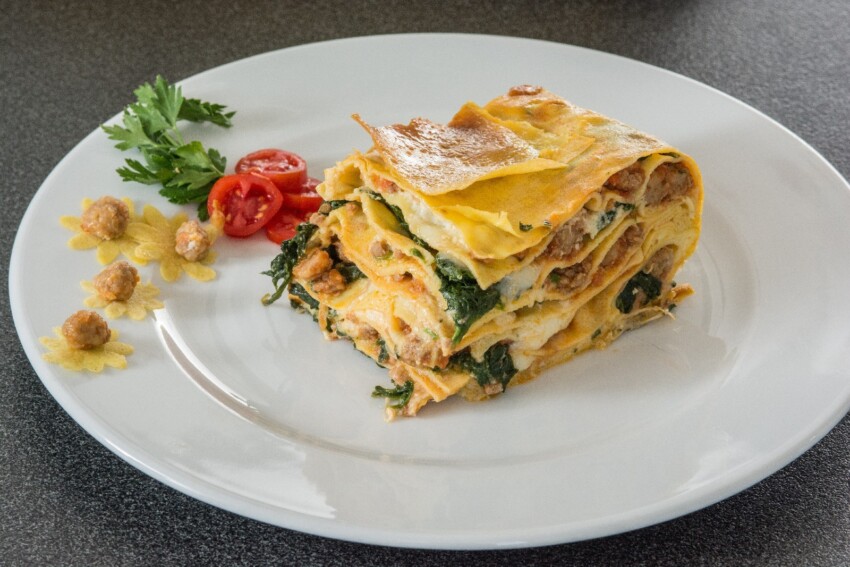
Originating from the Teramo culinary tradition but now widespread throughout the region are scrippelle, that is, thin pancakes very similar to French crêpes that form the basis of various dishes such as scrippelle ‘mbusse, scrippelle timbale and oven-baked scrippelle, which are filled and cooked in the oven in a similar way to cannelloni.
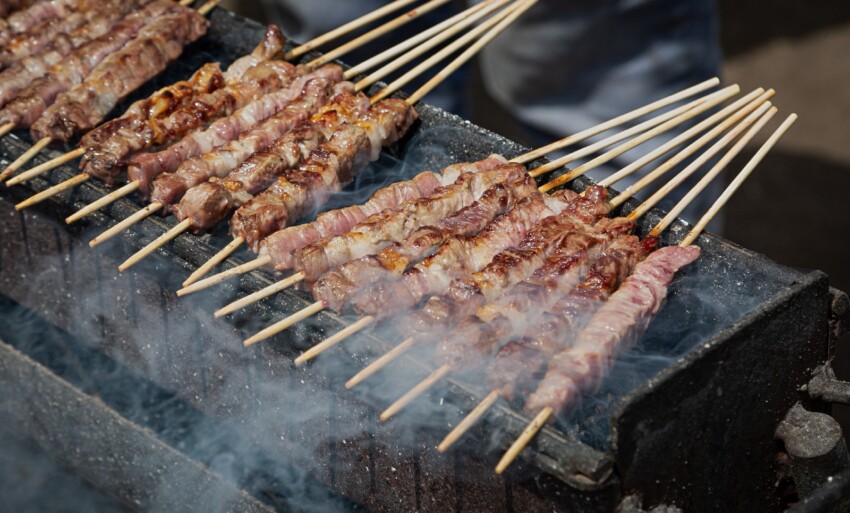
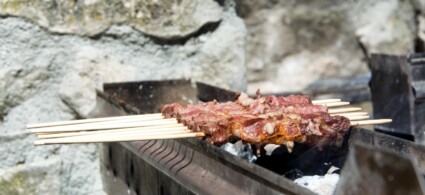
A dish that is symbolic of the region is certainly arrosticini, that is, morsels of lamb meat threaded onto skewers and cooked over a brazier. Arrosticini originate from the foothills area of the Gran Sasso d’Italia and were a common food in the traditional cuisine of farmers and herders.
Another typical dish from the mountain area is “pecora alla cottora”, a recipe dating back to the time of transhumance when old or dead sheep were eaten by shepherds who cooked them in special copper pots, called cottore. The dish is very simple and consists of lamb meat cooked for a long time and flavoured with herbs.
Typical of the coastal areas is, instead, fish brodetto, which originated as a poor man’s dish eaten by fishermen of the Adriatic using in the broth those fish that were difficult to sell because of poor quality. Now this dish presents itself as a true delicacy and has several variations in the cities of Silvi, Giulianova, Pescara and Vasto.
A typical Abruzzese dessert is the ferratella, a biscuit paste cooked by means of a double plate heated over fire that gives the sweet the shape of a waffle crossed by ribs; in some variations the sweet is rolled like a cannoli and filled with grape jam, pastry cream or chocolate.
Also worth tasting are the bocconotti, that is, small shortcrust pastry sweets that are filled with honey, pastry cream, jam or chocolate and dusted with icing sugar.
Finally, not to be missed are Sulmona confetti, a product from the city of Sulmona now famous throughout the world, and soft nougat with L’Aquila chocolate.
Abruzzo is a land rich in PDO and PGI products, that is, agri-food products that are the fruit not only of a territory but also of its history and the knowledge of its producers.
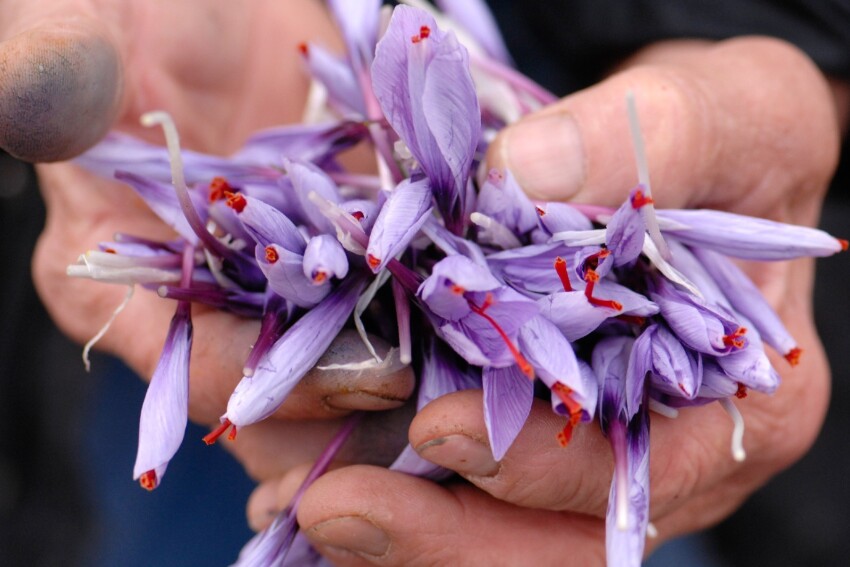
Among the PDO products from Abruzzo we have Extra Virgin Olive Oil “Aprutino-Pescarese”, Extra Virgin Oil “Colline Teatine” and Extra Virgin Olive Oil “Pretuziano delle Colline Teramane”; but L’Aquila Saffron is also considered PDO. Among inter-regional PDO products we have Italian Salamis alla cacciatora and Ascolana del Piceno Olive.
PGI products, instead, are Carrot from the Fucino Plateau and Fucino Potato, but also the White Veal of Central Apennines (inter-regional) and Lamb of Central Italy PGI (inter-regional)
Slow Food Abruzzo Presidia is a Slow Food project that aims to gather and support small local producers who have always been custodians not only of gastronomic traditions but also of truly ancient know-how.
The Presidia involve small groups of Abruzzese farmers who cultivate native fruit and vegetables, breed native breeds and produce not only special cheeses but also handmade products following recipes that have been passed down for years according to very strict principles. Slow Food’s activity aims not only to support these producers but also to enhance their value and help them become known.
Among the main products of Slow Food presidia we find excellent cheeses such as Canestrato di Castel del Monte, a cheese with a pronounced and spicy flavour produced from the pastures of the southern slope of the Gran Sasso, and Pecorino di Farindola, a product made in limited quantities using pork rennet which gives it particular aroma and flavours.
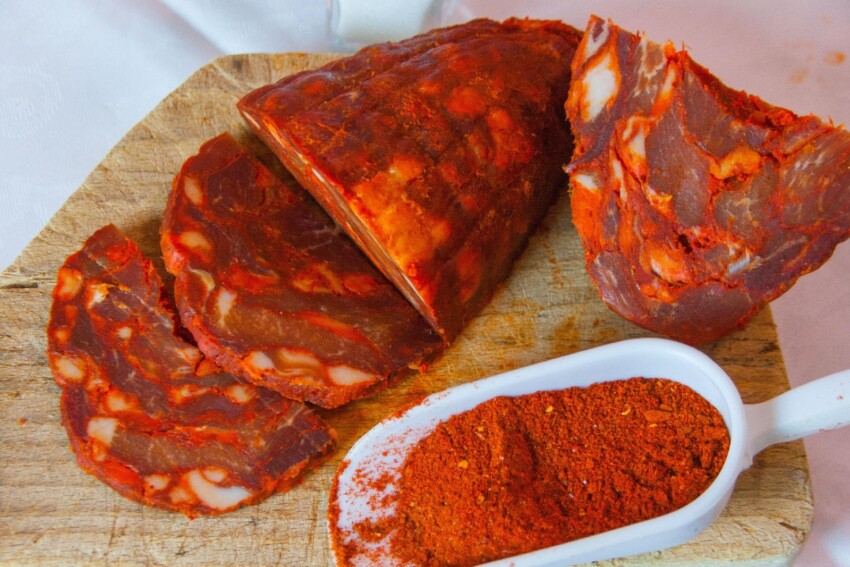
Among the cured meats we find Mortadella di Campotosto, still prepared by only two producers from Campotosto who use cuts of lean first-choice pork, Salsiccia di Fegato Aquilana, a sausage made with liver, heart and lung of pork and the addition of some meat, pork fat, salt and chilli pepper; the list of products continues with Salsicciotto Frentano, a traditional cured meat from the Sangro Valley made with pork, garlic and pepper, and Ventricina del Vastese, a salami with ancient origins that is made using the noblest parts of pork.
Among the cultivated products we have Chickpeas from Navelli, a cultivation carried out by very few farmers at an altitude of 700 – 800 metres in arid soil, and Paganica Beans, a very particular species cultivated in Paganica, Tempera, Onna, Bazzano and San Gregorio. Now internationally famous is the Lentil from Santo Stefano di Sessanio which grows in territories above 1000 metres altitude only on the slopes of the Gran Sasso.
Among the vegetables we find the Turquoise Potato which, produced between the Apennine peaks of the Gran Sasso, is characterised by an intense purple skin, and the Sweet Pepper from Altino produced according to eco-sustainable cultivation methods. Very particular and high-quality products are also the White Onion from Fara Filiorum Petri, the Dried Royal Fig from Atessa and the Intosso Olive.
Also not to be forgotten is Montonico Grape, whose bunch is large, elongated and the berries are yellowish-green in colour; the vine is now very rare and cultivated only in the municipalities of Bisenti and Cermignano.
Finally, we also find Solina Wheat from the Abruzzese Apennines and Honeys from the Abruzzese Apennines. Solina Wheat is a type of soft wheat cultivated in difficult mountain soils at varying altitudes from 500-600 to 1300-1400 metres following the principles of organic farming; Honeys from the Abruzzese Apennines, instead, are three multiflower, savory and witchcraft honeys that are produced on the L’Aquila mountain starting from a minimum altitude of 850 metres.
 Hotel
Hotel  Budget accommodations
  Apartments
  Family Hotel
  Luxury Hotel
  Resorts