Primae Noctis Rooms
Roccascalegna - 2 Via della Libertà
Book now
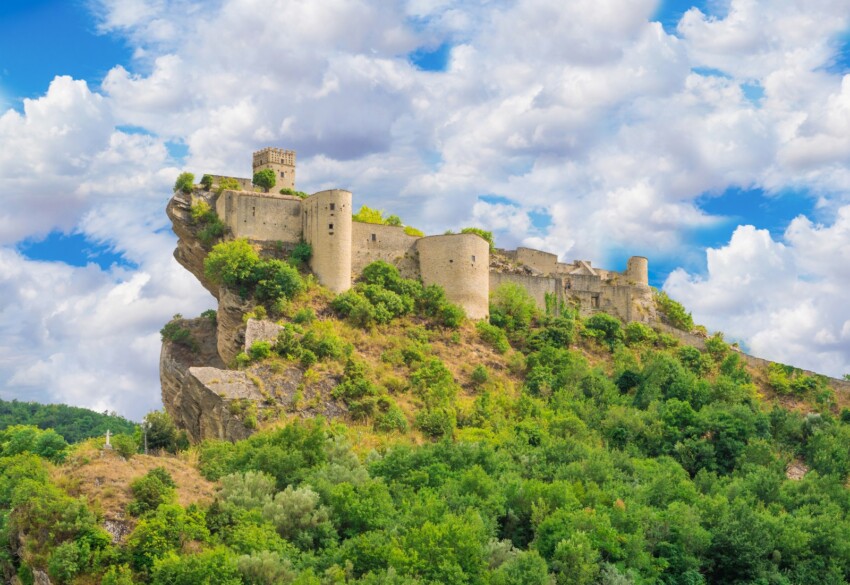
Roccascalegna is a charming village nestled in the Abruzzo hinterland, famous for its castle perched atop a rocky outcrop that commands views across the surrounding landscape. The town is believed to have developed around the 12th century as a Lombard stronghold controlling the Rio Secco Valley. There are several theories about the origin of the town’s name. Some believe Roccascalegna derives from “Rocca con la scala di legno” (rock with the wooden staircase), whilst others suggest that “scalegna” once referred to the cliff face upon which the fortress was built.
Historical sources indicate that the Lombards were the first to construct a tower on the site of the present-day castle, used to spot approaching enemies. It was during Norman rule, however, that the decision was made to expand the tower and build a proper fortress, which underwent various modifications over the centuries. At the foot of the castle, a small village gradually emerged, characterised by narrow winding streets, stone houses and ancient buildings.
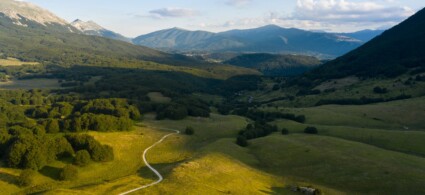
Today, Roccascalegna, with its peaceful medieval atmosphere and stunning panoramic views, is the perfect destination for a day trip combining history and nature.
The historic centre of Roccascalegna sits at the foot of the rocky outcrop that houses the castle. Walking through the village streets, you’ll discover several viewpoints offering breathtaking vistas across the surrounding territory, as well as small churches.
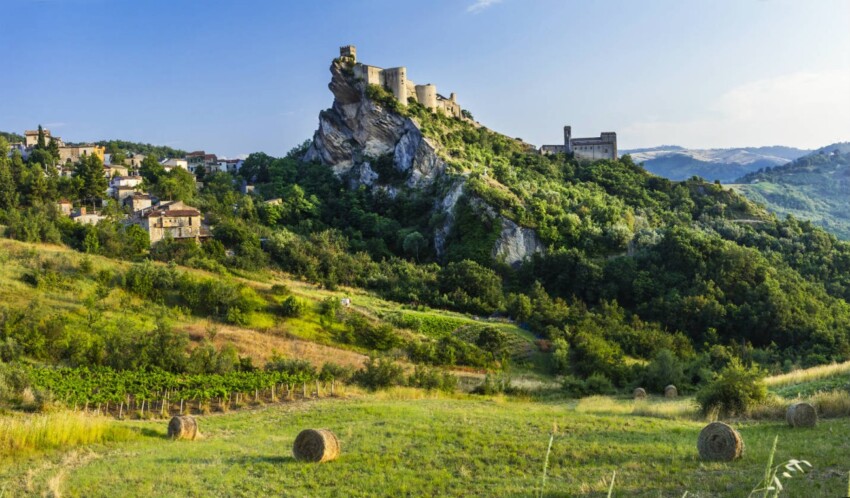
The Roccascalegna Castle began as a watchtower before being gradually expanded over time into a proper fortress. The castle dominates the Rio Secco valley, a tributary of the River Sangro, from high above. The fortress has been damaged and rebuilt several times, and what we see today is the result of restoration work carried out in 1996 by the local council.
Within the walls, visitors can explore several rooms, including the “Prison Tower” and the “Oven Tower”, connected to the Chapel of the Holy Rosary. The visiting route allows you to discover a room dedicated to weaponry, one displaying instruments of torture, and a section documenting local photographs and legends. Several spaces have also been used for temporary events and exhibitions. Beyond its historical significance, the castle merits a visit for the magnificent views over the surrounding countryside that greet its visitors.
Next to Roccascalegna Castle, you can visit the ancient Church of San Pietro, said to be the oldest in the town. The church appears to have been completed around the mid-16th century, whilst the bell tower is thought to date from 1805 and is believed to be a restoration of an ancient medieval tower. Inside, the church features three naves in Baroque style with altars dating from the 18th century. Externally, you’ll see a Baroque façade with a Romanesque portal featuring a rounded arch and a Baroque fresco on the lunette.
The Church of San Pancrazio was built around the 12th century, though by the 16th century historical records already described it as one of the most important churches in Chieti province. The religious building also included a monastery and cloister.
Externally, the Church of San Pancrazio features a rectangular façade built of stones, whilst the interior has two naves without an apse. Next to the abbey stands a cemetery that has been in use since the 19th century for burying village inhabitants.
The Church of Saints Cosma and Damiano was built in the 16th century for village residents who lived outside the town walls. Externally it has a very simple façade, whilst the interior features three naves, no transept and an apse. When visiting the building, you can admire numerous Baroque decorations, ornate coloured and gilded embellishments, whilst the barrel vaults are decorated with frescoes.
Roccascalegna is a small village in the Abruzzo hinterland with limited hotel facilities. The town is ideal for a day trip from larger nearby towns such as Fossacesia, Ortona or Vasto. These towns certainly offer a wider choice of accommodation at different price points.
The best way to reach Roccascalegna is certainly by car. From Pescara, take the A14 motorway to the Val di Sangro exit, then the SS652 towards Roccascalegna. From Sulmona, take the A25 to the Manoppello exit, then the SS81 towards Roccascalegna.
 Hotel
Hotel  Budget accommodations
  Apartments
  Family Hotel
  Luxury Hotel
  Resorts