Hotel Sporting
Vasto - Via San Tommaso 67
Set in Marina di Vasto, Hotel Sporting is 5 km from Vasto centre and offers a tennis court and outdoor swimming pool.
Book now
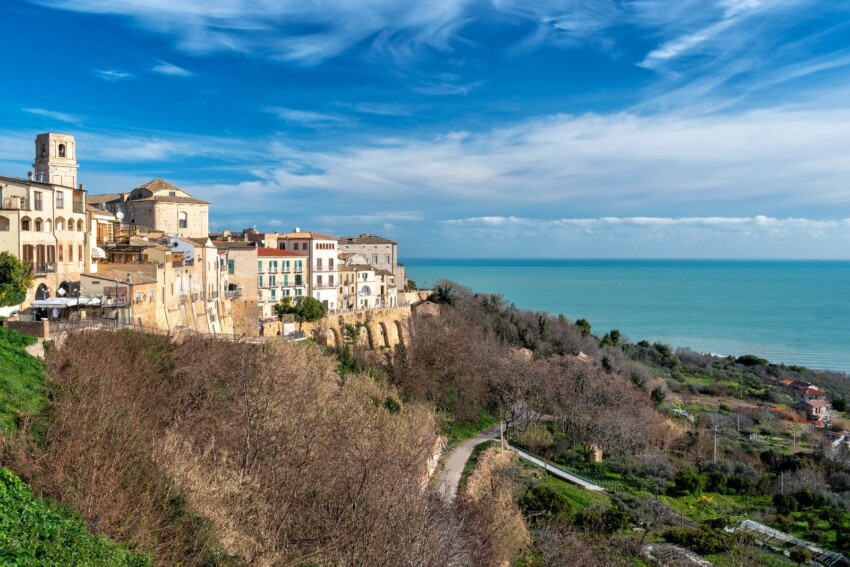
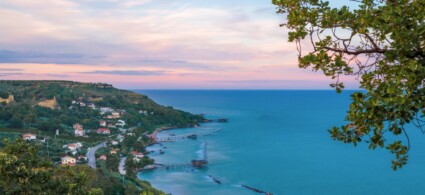
Overlooking what is known as the Golden Gulf – an expansive crescent-shaped bay characterised by golden sand – Vasto is renowned as one of Abruzzo’s most distinctive destinations. Known in antiquity as Histonium, Vasto is a captivating historic town located in southern Abruzzo, on the border with the Molise region.
Thanks to its position, Vasto has been regarded since ancient times as an important maritime settlement that emerged from the union of small villages along the Adriatic coast. Ransacked on several occasions, the city was destroyed in the early 800s AD and subsequently rebuilt as two separate localities, “Guasto d’Aymone” (meaning “City of Aymone di Dordona”) and “Guasto Gisone“, which were only unified in the 14th century. The term “Guasto” was a territorial subdivision used during Lombard rule, and it is from this term that the name Vasto is derived.
The various rulers who controlled the town over time have left their mark, and this historical heritage is now visible as you wander through Vasto’s streets. However, Vasto is primarily celebrated as a seaside destination thanks to its stunning beaches (awarded the Blue Flag designation several times) and the presence of the evocative Costa dei Trabocchi.
The Adriatic Sea provides a backdrop to a historic centre brimming with places worth discovering, experiencing and appreciating. Alongside ancient churches and medieval walls, Vasto also hosts defensive fortresses, aristocratic palaces and one of the region’s most important nature reserves.
The historical and architectural heritage combined with its natural attractions and beautiful beaches make Vasto an ideal destination year-round. The town offers a getaway that encompasses not only seaside pleasures but also culture, history and nature.
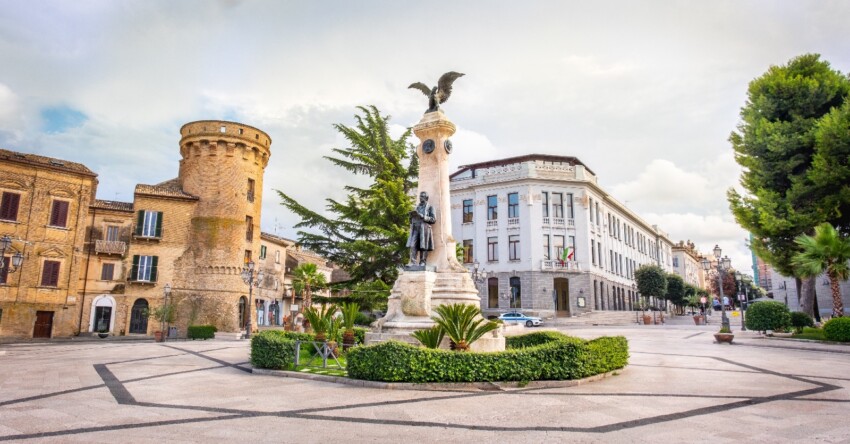
The true heart of the city is its historic centre, considered one of the best preserved in the entire region, centred on Piazza Gabriele Rossetti. The square is named after Gabriele Rossetti, an Italian poet, literary critic and patriot born in Vasto in 1783, honoured by a statue positioned in the centre of the piazza.
Here you can also admire the Torre di Bassano, built in 1439 by engineer Mariano di Jacopo. It originally formed part of the defensive city walls and was connected to Castello Caldoresco.
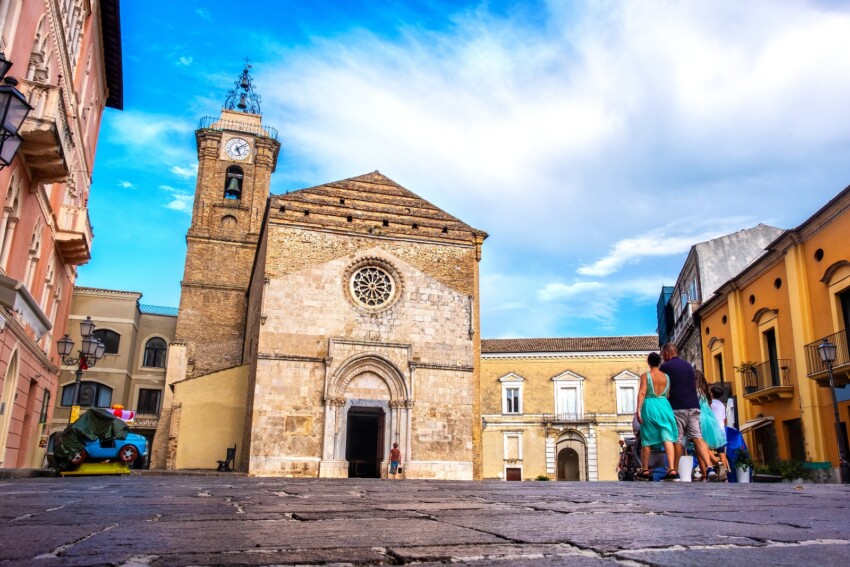
The Vasto Cathedral is believed to have been built in the 13th century, though it underwent restoration in the 17th and 19th centuries. Dedicated to San Giuseppe, it became a collegiate church in 1808 and then a cathedral between 1808 and 1853. The façade, with its portal and rose window, are original to the 13th century, whilst the interior was rebuilt in the early 1900s. Inside, the building features a single nave in neogothic style with fluted columns with green stripes and Corinthian capitals.
The bell tower standing beside the church dates to 1730 and is in baroque style with wrought iron railings. In the 19th century, the bell tower was enhanced with a mechanical clock whose chimes mark the rhythm of the town’s life.
Built by Sienese architect Mariano di Jacopo, Castello Caldoresco stands in Vasto’s historic centre on a promontory overlooking the coast and is considered one of the town’s most significant monuments. Commissioned in the 15th century by Giacomo Caldora, feudal lord and ruler of Vasto, it was erected on the foundations of a pre-existing fortress using precise military techniques.
Castello Caldoresco served as a defensive structure and originally featured a square plan with a central courtyard and four circular bastions. At the end of the 15th century, Innico D’Avalos ordered restoration work to update the complex to the latest defensive techniques. These interventions, which included reinforcing the perimeter walls and constructing large almond-shaped bastions – still visible today – gave the castle its current appearance.
Considered one of Vasto’s symbols, Palazzo d’Avalos dominates the town’s landscape with its grandeur. In the 15th century, feudal lord Giacomo Caldora had this palace built overlooking the sea on the site of pre-existing Roman and early medieval structures.
The complex was destroyed during the Turkish assault in 1566, but the noble D’Avalos family, when establishing their court in Vasto, rebuilt the edifice with the intention of enriching the historic centre. During the D’Avalos rule until the French occupation of 1799, the palace was regarded as a small local court and increasingly took on the appearance of a royal residence hosting the noble family.
Of considerable merit is the splendid Neapolitan garden desired by the D’Avalos and, thanks to restoration work, still open to the public. The Palace currently houses four museums: the Archaeological Museum, the Picture Gallery, a Contemporary Art collection featuring works by Italian and Spanish artists, and the Ancient Costume Museum.
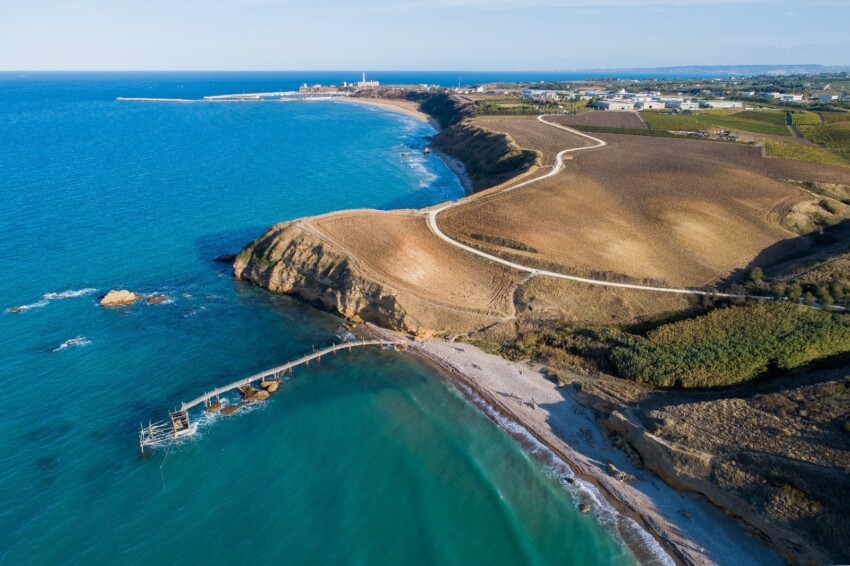
The Punta Aderci Nature Reserve forms part of Vasto’s natural heritage and is one of the town’s most beautiful locations. Spanning approximately 285 hectares from Punta Penna beach to the mouth of the Sinello river, the reserve is a natural paradise harbouring rare Mediterranean maquis plants and distinctive animal species.
The Punta Aderci promontory (26m above sea level) offers a spectacular 360° view over the entire reserve and surrounding sea, making it one of the finest spots to watch the sunset or sunrise. Within the reserve lie four beautiful beaches: Punta Penna, Libertini, Punta Aderci and Mottagrossa beach. The reserve is open to visitors year-round and access to both the reserve and beaches is free.
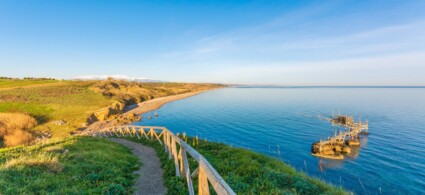
Along the Abruzzo coast between the towns of Ortona and Vasto, you’ll find numerous trabocchi – traditional wooden pile-dwelling structures that allowed fishermen to fish close to shore instead of venturing out to sea in boats.
Many of Vasto’s trabocchi, thanks to their unique locations, have inspired artists and writers including Gabriele D’Annunzio. These structures are no longer used for fishing, but fortunately some have survived and been converted into restaurants where you can dine whilst enjoying stunning views.
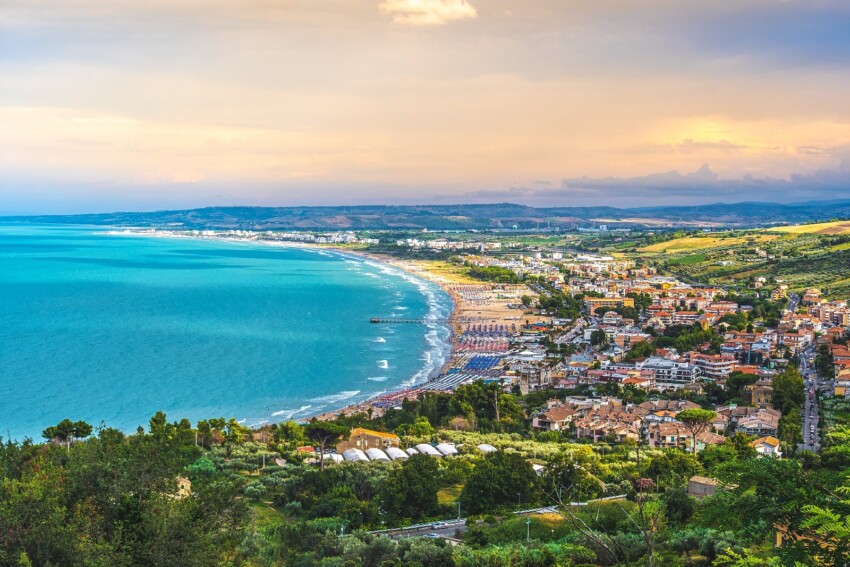
Vasto’s most famous beach is undoubtedly Vasto Marina6, a long stretch of soft, golden sand nestled in the namesake gulf. With both equipped facilities and gently sloping waters, Vasto Marina is particularly suitable for families with children.
Near Vasto’s port sits Punta Penna Beach7, a sandy shore surrounded by lush and wild nature. Easy to reach, well-equipped with facilities and featuring clear azure waters with gradually sloping depths, Punta Penna is a truly beautiful beach. Here you’ll also find the Punta Penna Lighthouse and Santa Maria di Pennaluce, a small 15th-century Romanesque church. In the northern part of the reserve lies Mottagrossa Beach8, a long pebbly shore that remains unspoilt and wild.
Just a short distance from the historic centre is the wild San Nicola Beach9, characterised by rocks and pebbles with fresh, clear waters that are somewhat choppier than other locations. Around San Nicola you’ll find other small, unequipped and pristine beaches as well as a beautiful trabocco. Finally, nestled between two splendid trabocchi is the inlet home to Canale Beach10, a pebbly shore surrounded by typical Mediterranean maquis flora with azure waters and gently shelving depths.
In the following map you can see the location of the main places of interest mentioned in this article.
Due to its strategic location, Vasto is a popular base for exploring various destinations in the area. The town offers numerous accommodations catering to different needs and budgets.
For those wishing to stay close to the beach, we recommend the Vasto Marina area, from where you can easily access the main beach, whilst those seeking a more cultural stay can choose accommodation near the historic centre.
Those looking for a peaceful retreat can opt for one of the many bed & breakfasts nestled in the countryside amongst olive groves, vineyards and wheat fields, where you can enjoy cool, breezy summers.
We offer a selection of hotels at Vasto to suit all categories of travellers. The most booked by tourists are the sea-facing hotels, often right on the beach. If you want to play it safe, choose one of the following: they are among the most booked hotels in Vasto, sorted by number of reviews.
If you prefer space, privacy and the ability to prepare your own meals to a hotel holiday, book a holiday home at Vasto. We recommend a few below, but in this case we advise you to book early because houses and apartments for rent at Vasto are in high demand.
Vasto is easily accessible from anywhere in Italy by car or train. By car, coming from the north, take the A14 motorway towards Bari and exit at Casalbordino – Vasto nord. From Rome, take the A24 motorway followed by the A14 to the Casalbordino – Vasto nord exit.
For travellers from Bari, take the A14 towards Bologna and exit at Montenero di Bisaccia – Vasto sud. From Naples, take the A1 to the Caianello exit, then continue along the SS85.
The nearest airport is Pescara, approximately 80 km from Vasto, connected to the town via the A14 or by coach services operated by Prontobus.
Vasto has two railway stations: Vasto – San Salvo station, which serves long, medium and short-distance services, and Porto di Vasto station, dedicated to regional connections. During summer, maritime services operate directly from Punta Penna Port, about 8 km from the town centre, to the Tremiti Islands.
What's the weather at Vasto? Below are the temperatures and the weather forecast at Vasto for the next few days.
Vasto is a charming seaside town on Abruzzo's southern coast, located approximately 80 km from Pescara, 110 km from Roseto degli Abruzzi and 190 km from L'Aquila.
 Hotel
Hotel  Budget accommodations
  Apartments
  Family Hotel
  Luxury Hotel
  Resorts