Hotel Federico II
LʼAquila - Via Strinella 6
Book now
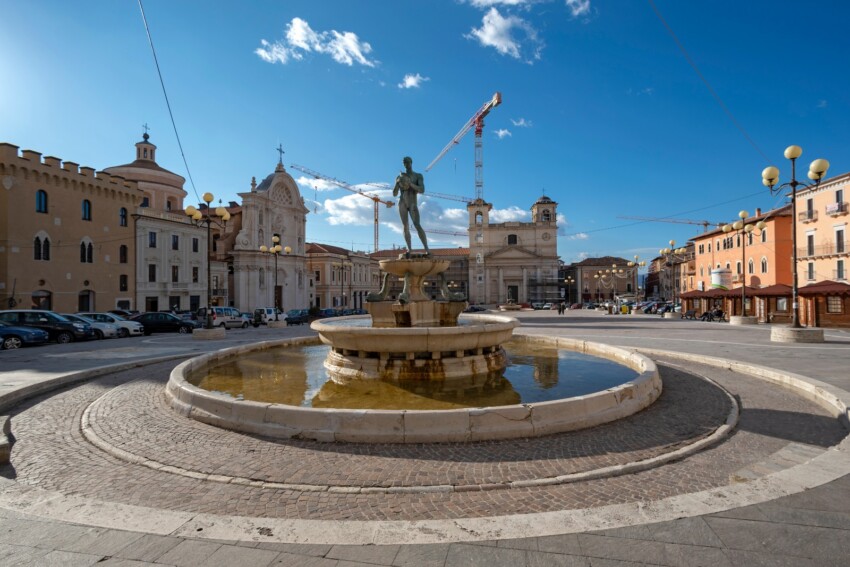
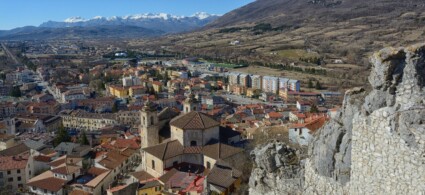
A vast array of architectural heritage comprising churches, palaces and buildings, alongside breathtaking natural surroundings and a rich history—this is L’Aquila, one of the most important towns in central Italy. Situated along the banks of the River Aterno at an altitude of 721 metres above sea level, L’Aquila is a destination that captivates every visitor with its charm. The historic centre rises in the middle of a high plateau, a position that makes the town one of the highest and coldest provincial capitals in Italy, while all around it are numerous small hamlets nestled in the green landscape. A town with a truly ancient history, L’Aquila is characterised from an urban planning perspective by two main streets, Corso Vittorio Emanuele II and Corso Umberto I, which intersect perpendicularly and meet at a point known as the Quattro Cantoni.
Although L’Aquila was struck by a devastating earthquake in 2009 that destroyed much of the buildings and disrupted the lives of its inhabitants, the town never surrendered and has worked tirelessly to restore its former splendour. Many structures have been already restored whilst others are still undergoing recovery, and the town continues day after day to reclaim its heritage.
The 2009 earthquake was not the only seismic event to impact L’Aquila, as the town had previously been struck by powerful earthquakes in both 1461 and 1703. Yet all these events have not allowed the town’s history to be lost. Fortunately, fragments of the medieval city walls remain visible, along with numerous Renaissance palaces and various buildings in both neoclassical and baroque styles that were constructed following the 18th-century earthquake.
On 14 March 2024, L’Aquila was named Italian Capital of Culture 2026 with the project “L’Aquila città Multiverso”.
The historic centre is located within a medieval fortification wall that has reached us virtually intact, whilst access to the town is through four main entrance gates: Porta Napoli, Porta Castello, Porta Roma and Porta San Sebastiano. Since its foundation, the town has been divided into four quarters, known as the Quarti, which are San Giorgio, Santa Maria Paganica, San Pietro Coppito and San Giovanni d’Amiterno.
According to an ancient legend, the symbolic number of the town is 99, as L’Aquila was born from the union of populations from 99 castles. For this reason, it is said that the town contains 99 piazzas, 99 churches and 99 fountains.
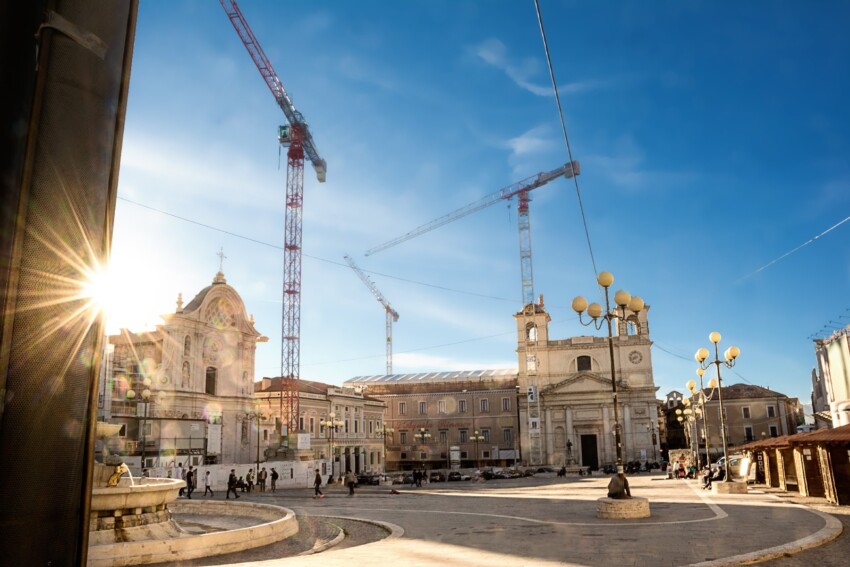
Cathedral Square, also known as Market Square, is the main piazza which until a few years ago also hosted the traditional town market. The name of this square derives from the presence of the Cathedral, erected in the late 13th century and also known as the Cathedral of Saints George and Maximus. The building’s façade is in neoclassical style and features three coats of arms: that of the Pontiff, the Metropolitan Chapter and the Archbishop. The interior, meanwhile, is characterised by a spacious central nave and two side aisles and preserves a small wooden choir and paintings dating to the 15th century.
The square also hosts the Church of Santa Maria del Suffragio, also called the Church of the Holy Souls, which was erected in 1713 in remembrance of the victims of the devastating earthquake that had struck the town a few years earlier. The interior features a Latin cross layout, characterised by a single nave with a rectangular apse. Externally, the façade is in late-baroque style and the religious building displays an impressive dome of over 35 metres, realised in the 19th century in neoclassical style.
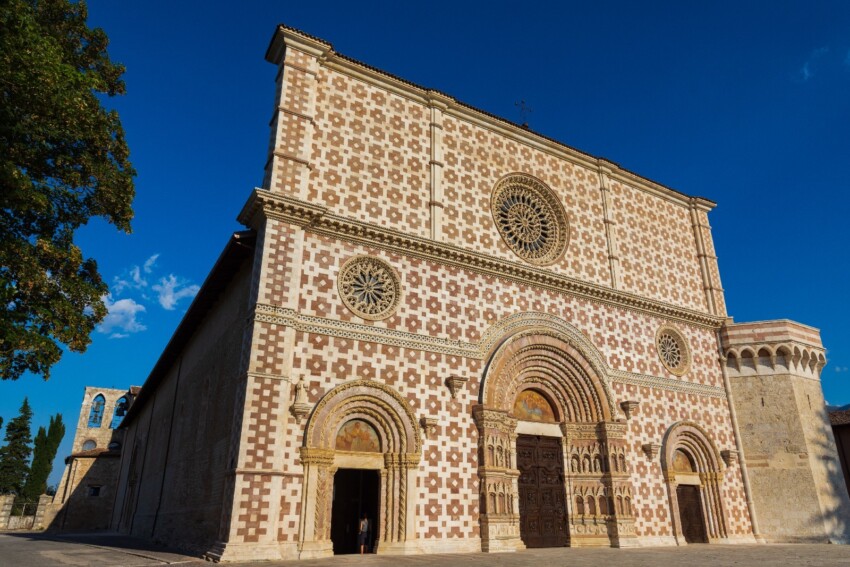
Located at Collemaggio, a small promontory outside the town walls, the Basilica of Collemaggio is considered one of the masterpieces of Abruzzo architecture. Regarded as the town’s most renowned and precious church, the Basilica of Collemaggio is particularly famous for its stunning façade.
Construction of the church began in the late 13th century thanks to Pietro da Morrone, founder of the Celestine order, who later became Pope Celestine V and is buried here. In honour of Celestine V, the town’s greatest and most important festival, known as the “Perdonanza Celestiniana”, is celebrated annually from 23 to 29 August.
The splendid rectangular façade, completed in the early 15th century and decorated with the typical pink and white marble, features a rose window framed by pilasters in the upper section, while the lower section has two smaller rose windows and three portals topped by frescoed lunettes. Internally, the Basilica comprises three naves with side chapels that house important frescoes dating to the first half of the 15th century.
Surrounding the building extends the Parco del Sole, a vast green area beloved by both locals and visitors. This park was created in the second half of the 20th century as an extension of the public gardens of the nearby Villa comunale, one of the town’s principal historic gardens.
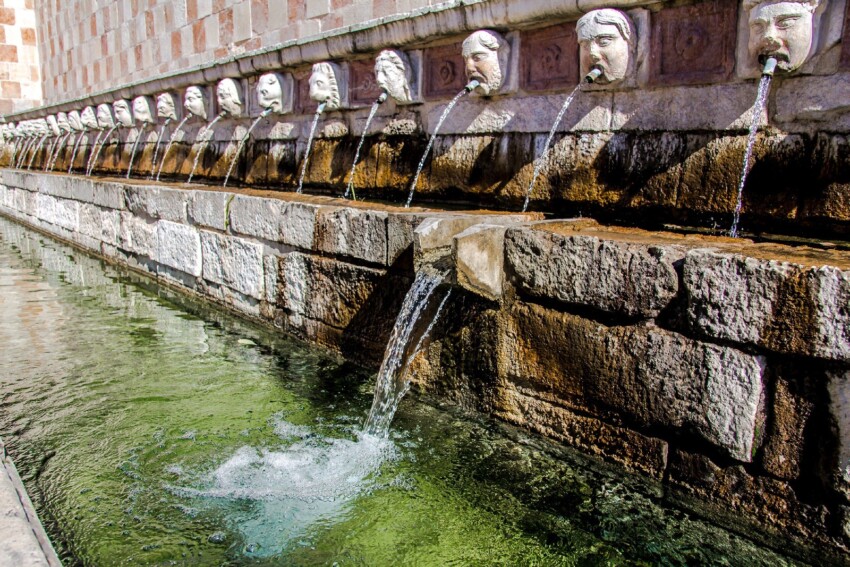
One of the most well-known places throughout L’Aquila and an undisputed symbol of the town is certainly the Fountain of the 99 Spouts. Located in the Rivera quarter, the fountain is characterised on three sides by walls of checkered white and pink marble, in which 99 sculptured faces are set. From the mouths of these masks, water flows through spouts into two large basins. According to tradition, the 99 spouts positioned on three sides are said to symbolise the 99 castles that constituted the city of L’Aquila in the 13th century.
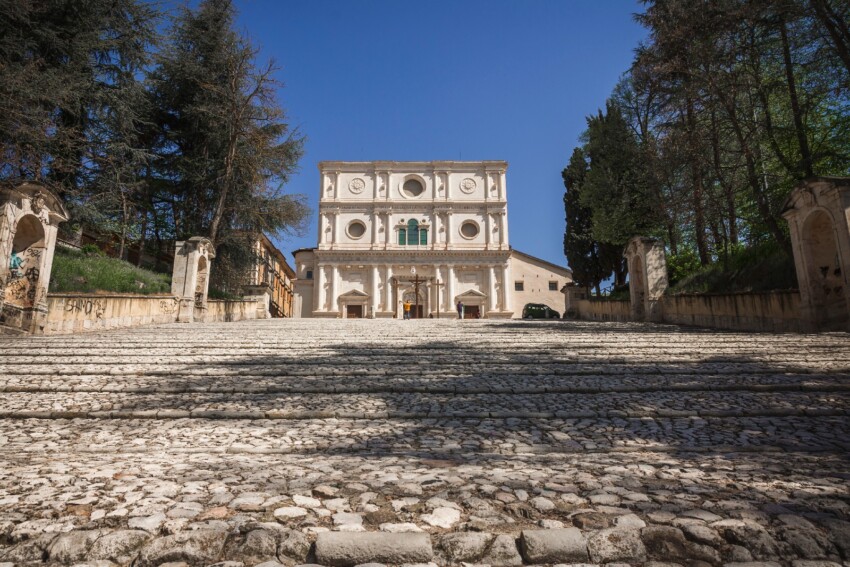
Built in the mid-15th century by San Bernardino da Siena, a Franciscan friar and preacher, the Basilica of San Bernardino is considered a true architectural masterpiece. Destroyed by the 18th-century earthquake and subsequently rebuilt in baroque style, the Basilica also suffered substantial damage during the 2009 earthquake.
Of particular interest is its façade, which has a rectangular form and features three orders of paired columns. In the lunette above the portal is a bas-relief of the Madonna with Child and Saints. Inside, the building comprises three naves, with the central nave covered by a coffered ceiling embellished with gold leaf. This ceiling was created in 1730 by Ferdinando Mosca, who also designed the magnificent organ found on the counter-façade.
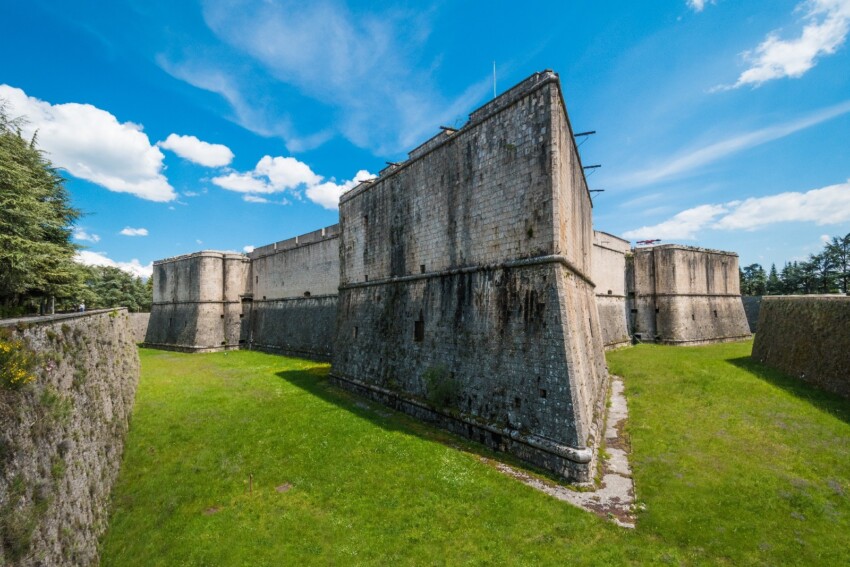
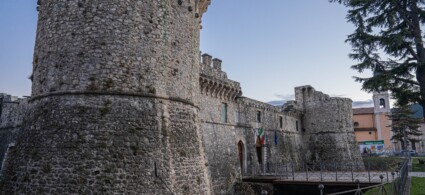
Located at the town’s highest point, the Spanish Fort was commissioned in 1534 by the Spanish viceroy Don Pedro di Toledo after the Spanish definitively conquered L’Aquila in 1529. The building has a square floor plan with high, thick bastions surrounded by a moat 14 metres deep and 23 metres wide. This fortress never served military functions but for a long time provided lodging for army troops.
In the bastion to the right of the entrance is the skeleton of a mammoth, discovered in 1954 in the Madonna della Strada hamlet in Scoppito, 15 km from the town; unfortunately it remains closed to the public due to restoration work on the fort’s chamber that houses it.
Before the earthquake, the Superintendence and the National Museum of Abruzzo were located here; now, right in front of the fortress entrance, stands a beautiful wooden auditorium designed by Renzo Piano as a venue for concerts and performances after the earthquake made the one inside the castle unusable. The area around the fort features expansive green space where you can stroll, jog or settle down with a good book in peace and quiet.
The Luminous Fountain is a work created in 1934 by artist Nicola D’Antino and is characterised by a circular basin that holds two bronze female statues holding aloft a “conca abruzzese”—a traditional vessel used especially for carrying fresh water. The Luminous Fountain earned its name because in the evening a suggestive interplay of lights on the water creates a truly magical atmosphere. It’s particularly evocative in winter, when it is often covered with a layer of ice due to the cold temperatures.
The National Museum of Abruzzo was once housed within the Spanish Fort but is now located in the former municipal slaughterhouse, not far from the Fountain of the 99 Spouts. Regarded as the region’s most important museum, the ground floor galleries showcase works that tell the history and development of Abruzzo art.
Among the most appreciated works are the painted panels of the Madonnas of Abruzzo dating to the 14th and 15th centuries, works by Andrea de Litio and Giacinto Brandi, and portraits of San Bernardino da Siena.
Built in white stone, two metres thick and 4.8 km long, the walls surrounding L’Aquila were completed in 1316. Along the perimeter stood 86 crenellated towers, among which the Civic Tower stood out, and there were 19 access gates connecting to the surrounding territory, historically considered an integral part of the town.
Over time, many gates were sealed or demolished; those we recommend visiting are:
In the following map you can see the location of the main places of interest mentioned in this article.
The Perdonanza Celestiniana is the most important historical, religious and social event in L’Aquila’s calendar. This event, now renowned worldwide, reaches its climax on 28 August with the opening of the Holy Door of the Basilica of Collemaggio.
The story tells that Pietro Angelerio da Morrone, upon learning of his election as Pope whilst in a hermitage near Sulmona at the age of 79, chose L’Aquila as the location for his coronation. He was thus crowned Pontiff with the name Celestine V on 29 August 1294 in the Basilica of S. Maria di Collemaggio, and decided on this occasion to grant a special indulgence, called the Great Pardon.
To obtain this indulgence, the faithful needed, after confession and repentance, to pass through the Holy Door of the Basilica.
Every year on 28 August, the opening of the Holy Door is renewed. The Procession of the Bull, with hundreds of people in period costumes, departs from Piazza Palazzo (where the Bull resides, in the Town Hall Tower) and arrives at the Basilica of Santa Maria di Collemaggio. The document promulgated by Celestine V is carried by the Lady of the Bull, accompanied by the Young Lord.
Upon reaching the Basilica at the end of the procession, the Mayor reads the document and subsequently a Cardinal appointed by the Vatican orders the opening of the Holy Door. The Bull will be displayed in the Basilica until the following day, 29 August, when the Holy Door is closed and the Bull is returned to the Town Hall.
One of the best areas to stay in L’Aquila is undoubtedly its historic centre, where you can find numerous accommodations, such as hotels, bed & breakfasts and apartments. The town centre zone is where not only the majority of attractions are concentrated, but also shops, restaurants and venues where you can stay late into the evening.
For those who prefer to stay surrounded by nature‘s greenery, the town also offers many accommodations located in the surrounding hills where you can enjoy a stay characterised by tranquillity.
L’Aquila is easily accessible by car from major Italian cities. From Milan, take the A1 motorway towards Bologna, then join the A14 (Adriatic) motorway Bologna-Bari until the Teramo-Giulianova-Mosciano exit. From here, take the Teramo-Mare dual carriageway towards Rome/L’Aquila, then join the A24 near Teramo and continue to the L’Aquila East exit. From Rome, you can reach L’Aquila in just over an hour by car via the A24 motorway Rome-L’Aquila-Teramo and take exit 14.
Those wishing to reach the city by air can use Pescara airport, which is less than 100 km from L’Aquila, as well as Rome’s Fiumicino and Ciampino airports. From the airports, you can reach the city by hiring a car or by taking direct buses operated by Gaspari Bus and Flixbus.
L’Aquila is also connected to other cities in both Abruzzo and across Italy via several bus services. Daily services run by the regional company TUA connect L’Aquila to Teramo, Chieti, Pescara and Rome. For information on timetables and destinations, visit the official TUA Abruzzo website.
Other bus companies serving L’Aquila include Flixbus, Gaspari Bus, Baltour and Roma Marche Linee, which connect the city to major Italian destinations such as Bari, Bologna, Florence, Milan, Naples, Padua and Venice.
If you prefer to travel by train, it’s worth knowing that L’Aquila has a railway station on the Terni-L’Aquila-Sulmona line, which serves these three cities. The service is not particularly efficient, so we recommend opting for bus services instead.
What's the weather at L’Aquila? Below are the temperatures and the weather forecast at L’Aquila for the next few days.
L'Aquila is the regional capital of Abruzzo and lies 90 km from Rome and 100 km from Pescara.
 Hotel
Hotel  Budget accommodations
  Apartments
  Family Hotel
  Luxury Hotel
  Resorts