Sport Village Hotel & Spa
Castel di Sangro - Località Piana S. Liberata
Book now
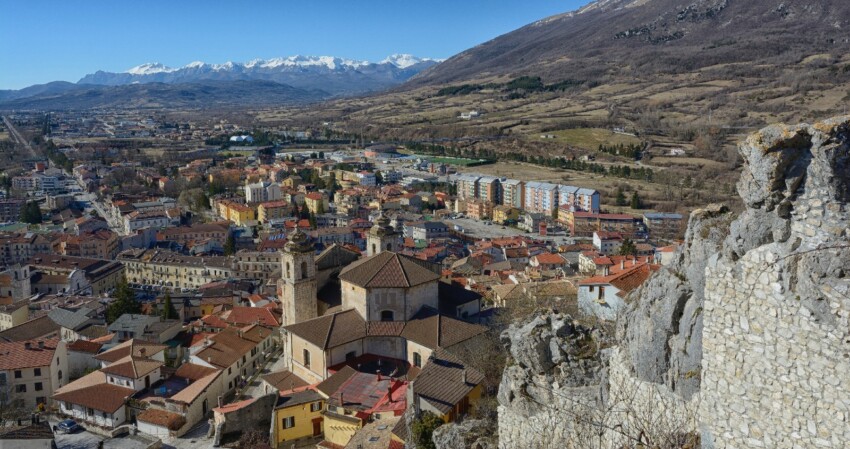
A characterful Abruzzese village situated at 800 metres altitude, Castel di Sangro is an ideal destination for those seeking a stay centred on history, nature and relaxation. The town has managed to preserve part of its medieval structure, and La Civita remains worth visiting – the highest and oldest quarter of the city, where you can also admire the Basilica of Santa Maria Assunta.
Castel di Sangro, considered the main hub of the Alto Sangro region, where you’ll find the famous ski resorts of Roccaraso, Pescocostanzo and Rivisondoli, sits along the right bank of the Sangro River and was long considered the “Gateway to Abruzzo“. In the nineteenth century, numerous travellers and merchants passed through Castel di Sangro, which was an essential waypoint for accessing the surrounding territories.
The town’s position was equally strategic for transhumance – the seasonal movement of livestock – so much so that a public Customs House was established here to control the movement of animals and goods. By the mid-eleventh century, a castle was built on Colle San Giovanni, the city’s highest point, for defensive purposes, though it was abandoned in the sixteenth century when a settlement began to develop lower down, where a baronial feudal palace subsequently arose.
Unfortunately, during World War Two, Castel di Sangro lay close to the Gustav Line and the town suffered heavy bombing that destroyed many buildings. During the reconstruction period, however, proximity to Roccaraso, an important Abruzzese tourist destination, and improved transport links helped Castel di Sangro regain its former splendour and become an increasingly well-known and visited resort.
A town best explored on foot, Castel di Sangro boasts a truly unique architectural heritage thanks not only to its beautiful churches but also to the historic palaces and buildings throughout. Don’t miss a visit to the evocative medieval village of Roccacinquemiglia, an ancient hamlet of Castel di Sangro.
Piazza Plebiscito1 is the current heart of the town and its most modern area, whilst the city’s oldest quarter is found at Colle San Giovanni and is characterised by the remains of the medieval castle and fortified houses dating to the sixteenth century.
The Basilica of Santa Maria Assunta stands in La Civita, the city’s oldest quarter, and is considered the town’s main church. The Basilica has medieval origins but was rebuilt in baroque style in the eighteenth century with a Greek cross plan and three aisles.
Inside the building you can admire several eighteenth-century canvases, some fine wooden works and, atop the baptistry, a bronze group depicting the Baptism of Christ. The façade is enriched with recesses of saints and two twin side bell towers, whilst the precious fifteenth-century loggia surrounding the building was salvaged from the previous church that was demolished.
Built in 1430 at the behest of the Marchesini family, the Church of St John the Baptist underwent various alterations over the years and was largely destroyed in the 1943 bombing.
The church overlooking Piazza del Plebiscito was rebuilt according to the original design and features a monumental stone façade with two orders of pilasters. The squared bell tower is the original, whilst the interior is in baroque style with three aisles and various paintings dating to the eighteenth century.
Located at Colle San Giovanni, Palazzo De Petra now houses the Pinacoteca Patiniana, a gallery dedicated to artist Teofilo Patini. The building preserves many valuable works by the artist and his pupils; most of the works depict the pastoral life of Castel di Sangro and describe the living conditions that characterised the town’s poorer classes in the nineteenth century.
The Renaissance palazzo, which belonged to the De Petra family, was also known as the “House of the Lion” for the sculpture that stood above the palazzo’s main doorway and served as the family’s heraldic symbol. The building has retained its original fifteenth-century appearance and showcases a blend of different styles with Gothic arches, bifurcated windows and Renaissance decorations in the upper loggia.
The medieval Castle built on the city’s highest point over the remains of an earlier fortress was constructed for military and defensive purposes. The structure was owned by various noble families of the area, including the Di Sangro.
Abandoned around the sixteenth century, when a settlement began to develop in the lower part of town, the Castle was severely damaged by the Maiella earthquake of 1706. Today you can admire the irregular square plan of the fortress and the three circular towers, the largest and oldest of which, called the keep, was used as a guard post.
The Museo Civico Aufidenate is housed in a former convent and contains archaeological finds unearthed in the territory and belonging to various historical periods.
Among the most noteworthy pieces are two important inscriptions in the Oscan language, architectural and sculptural elements of a funerary nature and a curious section dedicated to fly fishing, an activity widely practised in the territory of the Abruzzo Fauna Park.
The medieval village of Roccacinquemiglia is a small hamlet of Castel di Sangro perched on a rocky outcrop at 1,121 metres altitude. In the eleventh century, the presence of the Convent of S. Maria di Cinquemiglia led to the formation of a proper village in this area with its own castle and defensive walls.
Unfortunately, several earthquakes caused considerable damage to the convent, of which only a few remains can be seen today. As a result, the area was gradually abandoned. During World War Two, this area suffered heavy bombing that caused its near-total destruction.
In the following map you can see the location of the main places of interest mentioned in this article.
Castel di Sangro is a town offering a wide choice of accommodation, from charming bed and breakfasts to welcoming hotels. The location of Castel di Sangro makes it an ideal base for reaching nearby popular destinations such as Roccaraso and Rivisondoli.
The historic centre is certainly the best area in which to stay to explore the town’s historic and architectural treasures, whilst quieter outlying areas allow you to choose accommodation immersed in natural surroundings.
Castel di Sangro is easily accessible by car. From Ancona you need to take the A14, then the A25 towards Rome until the Pratola Peligna – Sulmona exit; from there continue on the SS 17 towards Castel di Sangro.
From Naples, take the A1 towards Rome until the Caianello exit, then continue first on the SS 158 and then on the SS 17. Those coming from Rome can reach Castel di Sangro via the A25 until the Pratola Peligna – Sulmona exit and then continue on the SS 17.
Reaching Castel di Sangro by public transport is more complicated since the railway station is no longer in use. However, the town is well connected to other Abruzzese destinations by bus operated by TUA.
What's the weather at Castel di Sangro? Below are the temperatures and the weather forecast at Castel di Sangro for the next few days.
Castel di Sangro is a charming Abruzzo town located in the Alto Sangro valley, approximately 12 km from Roccaraso, 15 km from Rivisondoli and 115 km from Pescara.
 Hotel
Hotel  Budget accommodations
  Apartments
  Family Hotel
  Luxury Hotel
  Resorts