Il Fortino
Celano - SS696 14
Book now
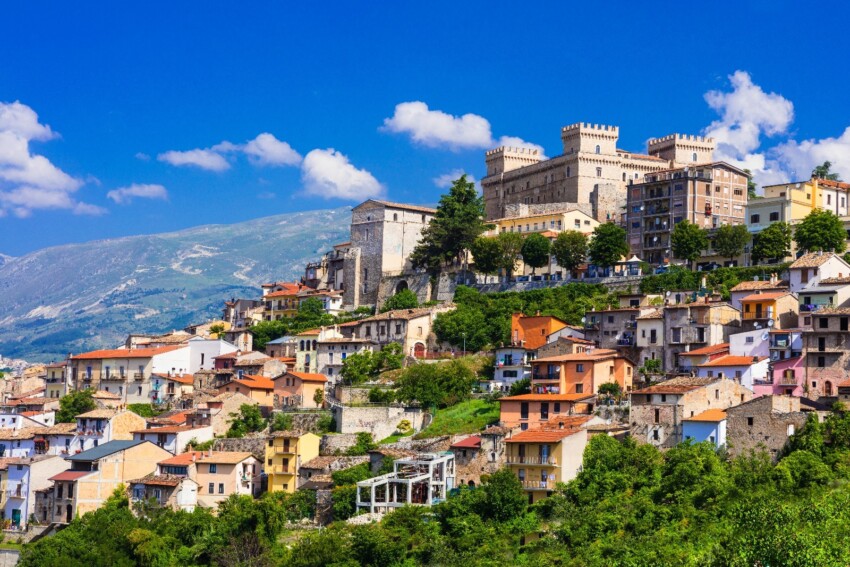
Nestled at the foot of Monte Tino at 860 metres above sea level, Celano is one of the principal towns of the Marsica region and boasts a genuinely welcoming and well-maintained historic centre. The town overlooks the Fucino plain and its territory is partly included within the Sirente-Velino Regional Nature Park.
This charming town has remarkably ancient origins and over the centuries has experienced various rulers, belonging to families such as the Piccolomini and the Sforza. However, this place is particularly renowned as the birthplace of Tommaso da Celano, one of the first disciples of St Francis of Assisi, and because Leonardo da Vinci, following a journey to Abruzzo, is said to have chosen to use paper produced by Celano’s celebrated paper mill to create some of his drawings.
Surrounded by the Sirente-Velino mountain range, Celano offers breathtaking landscapes and numerous nature trails for hiking and trekking enthusiasts. As for the town centre, in its highest part stands the Castello di Celano, which overlooks the entire village.
Celano is a town that has managed to preserve the typical medieval urban layout. The town is characterised by enchanting alleyways that wind between ancient houses, churches and noble palaces, leading to Colle San Flaviano where the Piccolomini Castle stands.
Walking through the streets of the village you can discover various buildings that tell the story of this ancient and evocative Abruzzo centre, whilst outside the town numerous trails lead you to discover its natural heritage.
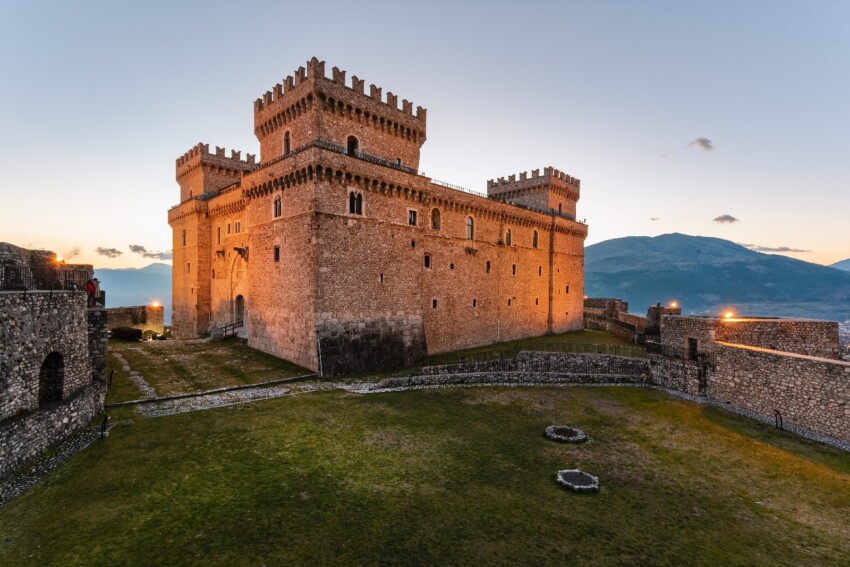
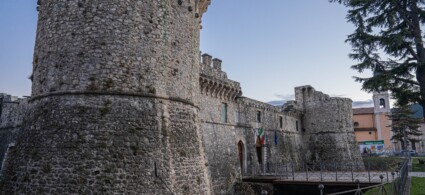
The majestic Piccolomini Castle rises on the Hill of San Flaviano in the highest part of the town of Celano. Built in 1392 by Count Pietro Berardi, very probably on the remains of a pre-existing wooden fortification ordered by Frederick II of Swabia, Celano Castle now presents a blend of medieval and Renaissance architectural elements. Originally constructed for defensive purposes, the fortress was later transformed into a noble residence.
Today we can admire the surrounding walls with 11 shield-shaped towers and 5 semi-cylindrical turrets. Inside, a drawbridge allows you to cross a moat and enter the Castle, a building with a rectangular floor plan with four square towers at the corners. The building spans three levels and overlooks a courtyard where there is a well used for collecting rainwater.
In 1915, unfortunately, the manor was severely damaged by the Marsica earthquake and only in 1938 did the castle pass into the ownership of the Italian State, which oversaw its restoration works. Inside the castle you will now find the headquarters of the Museum of Sacred Art of the Marsica and the Torlonia Collection of Fucino Antiquities.
The Parish Church of San Giovanni Battista was completely rebuilt in the 13th century following the destruction of the town by Frederick II of Swabia in 1223. The external façade is very simple and made of locally quarried stone cut into dressed blocks. The portal is decorated with a lunette featuring the Madonna and Child between St John the Evangelist and Pope Boniface IV, who was from the Marsica region.
The interior has a three-nave layout and is decorated with numerous coats of arms of noble Celano families and, in the right side aisle, with valuable 15th-century frescoes. Also of great value are the 18th-century wooden choir and the gilded wooden baptismal font dating from the 16th century, whilst beneath the main altar lie the urns of the Holy Martyrs of Celano, Simplicio, Costanzo and Vittoriano.
The Church of Santa Maria in Valleverde dates from 1508 and features a single nave and important works inside, such as the 16th-century wooden choir. On the right side are two large altarpieces, whilst on the left are three chapels adorned with precious frescoes of the Virgin created by Paolo Zoppo in 1558.
At the level of the presbytery, a staircase leads down to the underlying “Paradiso crypt” which has a polygonal shape and is decorated with splendid 16th-century frescoes. Adjacent to the church is the Franciscan convent with a cloister dating from the 15th century and an arcade with walls decorated with lunette paintings. Inside the convent you can visit the rich Library of Santa Maria and a museum of sacred works.
The Church Madonna delle Grazie, formerly known as the Church of San Giovanni Capodacqua, dates from the 11th century, and was the only religious building to be spared during the devastation of the town by Emperor Frederick II.
Subject to various restoration works, the church is characterised inside by three naves separated by mighty columns and features a 16th-century wooden altar, whilst the façade is gabled with elegant sculptural decoration on the architrave of the main portal. Beneath the church’s floor have been found the remains of a cemetery area used until 1932.
The Aielli-Celano Gorge, more simply known as the “Celano gorge”, is located between the municipalities of Celano, Aielli and Ovindoli within the Sirente-Velino Regional Nature Park. Carved for over four kilometres by the Rio La Foce stream, the gorge has rocky walls that can feature narrowings of around 3 metres and at their highest points reach almost 200 metres high.
Within the gorge there are two types of routes. The lower section is suitable for those who enjoy hiking, whilst the upper section is certainly reserved for canyoning experts. Beyond the splendid natural landscapes near Celano’s gorge, you can also encounter various animal species, such as the Eurasian griffon, the Eurasian eagle-owl, the peregrine falcon and occasionally wild boar.
In the following map you can see the location of the main places of interest mentioned in this article.
If you wish to fully appreciate the charm of Celano, we recommend choosing an accommodation in the historic town centre. Celano boasts a wide choice of facilities, from delightful bed and breakfasts to hotels often housed in historic buildings. Some even feature splendid panoramic terraces with views over the surrounding mountains.
Those preferring a stay in nature and relaxation can choose accommodation outside Celano, in facilities set within green surroundings. In winter, moreover, this location can prove to be an excellent base for reaching the Ovindoli-Magnola ski resort, which is just 12 km from Celano.
Reaching Celano by car is straightforward from Italy’s major cities. From Ancona you first need to take the A14 and then the A25 towards Rome until the Aielli-Celano exit. From there continue along State Road 5 and then State Road 696 towards Celano.
From Rome, the town is easily reached by first taking the A24 and then the A25 towards Pescara until you reach the Aielli-Celano exit, then continuing along State Road 696 towards Celano. From Naples, you need to first take the A1 towards Rome until the Cassino motorway exit, then continue along the Cassino – Sora – Avezzano Dual Carriageway and finally take the A25 until the Aielli-Celano exit.
The nearest airport is Abruzzo Airport, located in Pescara approximately 100 km away and easily reached by car via the A25 until the Aielli-Celano exit.
The town also has Celano-Ovindoli railway station, which connects Celano with other Abruzzo towns such as Avezzano, Aielli, Sulmona and Pescara. The TUA bus company guarantees bus connections with other locations such as Ovindoli and Avezzano.
What's the weather at Celano? Below are the temperatures and the weather forecast at Celano for the next few days.
 Hotel
Hotel  Budget accommodations
  Apartments
  Family Hotel
  Luxury Hotel
  Resorts