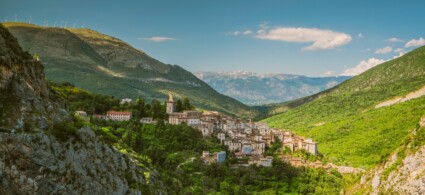
A small inland town in Abruzzo, Cocullo is located 45 km from Avezzano, 80 km from L'Aquila and 137 km from Rome.
During Lombard rule, the city was heavily fortified and a defensive watchtower was constructed during this period. In medieval times, the counts of Celano seized control of the city and built a castle on the remains of the Lombard tower, which later passed into the hands of the Piccolomini family.
Cocullo is also known as the “town of serpents” and the origins of this name are linked to the Marsican cult of the goddess Angizia, who was believed to govern fire and serpents. This belief was so deeply rooted that the Romans were convinced that healers in this city used the venom of these animals.
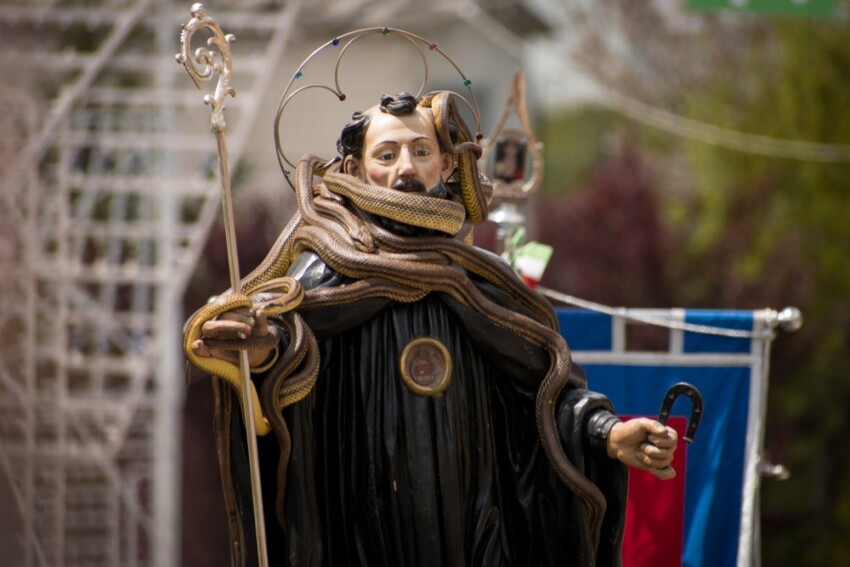
With the arrival of Christianity, this pagan festival took on a more religious significance. San Domenico, now the town’s patron saint, is said to have stayed in Cocullo around the 10th century and given relics of the mule’s iron shoe he rode as a gesture of protection for the local people against snakebites in particular. Since then, every May the “Festival of the Serpent Handlers” takes place, consisting of a procession carrying the statue of San Domenico covered with serpents.
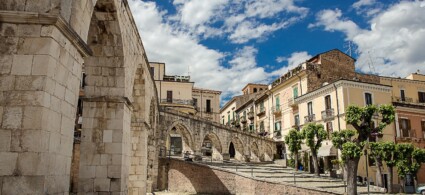
The village can be comfortably explored entirely on foot, wandering through its narrow cobbled streets lined with numerous churches, ancient houses and small shops. Walking through the historic centre’s streets, you can retrace and discover the town’s history. The upper part of the village, where the San Nicola Quarter stands, holds the heart of the historic centre which encompasses one of the oldest and best-preserved areas. A few remains of the medieval walls and gates that once allowed entry to the city are still visible here, such as Porta Ruggeri, named after a family of Celano feudal lords, Porta Renovata, which overlooks the valley to the south, and Porta di Manno.
In the upper part of the village stands the medieval tower, which was later converted into the bell tower of the church of San Nicola. Built by the Lombards around the 12th century using stone blocks, the tower originally served a lookout function. The tower stands separate from the church and now features a bell chamber topped by two bifora windows. The civic clock was only added in the 19th century.
The church of San Nicola, also built around the 12th century, was created by modifying the layout of an ancient castle. The façade is very simple and primitive, while the interior features a rectangular plan divided into three naves with a barrel vault.
The Church of Maria delle Grazie dates back to the 13th century and is believed to have been built on the site of a former temple dedicated to Jupiter. The church’s current appearance is the result of alterations that transformed the medieval layout into late Baroque style. The façade, divided by three pilasters, houses a rose window, an architrave depicting the Agnus Dei, and two 16th-century statues placed in two niches.
The interior has a single nave and features fine frescoes from the 16th century depicting the “Deposition” and the “Crucifixion”. Near the side entrance, there is a triptych of Sant’Antonio, Mary Magdalene, and Sant’Amico.
Records indicate that a religious building was constructed here in the 16th century, but the sanctuary we see today dates to the 20th century. What strikes you when observing the Church of San Domenico is the large drum cupola flanked by a bell tower with a pyramidal spire. The façade is built in stone blocks, whilst the interior features a single nave plan with a semicircular apse at the centre, where the high altar stands.
On the right side there is a finely decorated wooden pulpit, whilst on the left opens the chapel of San Domenico. This chapel also houses a small bell which tradition dictates the faithful ring with their teeth on the feast day. Every first of May the procession for the Feast of San Domenico Abate departs from here with the ritual of the Serpent Handlers. During this celebration, numerous serpents, collected a few months earlier from the countryside by the serpent handlers, are placed around the statue of San Domenico which processes through all the streets of the town centre.
Cocullo is a truly small town with a slow and relaxed pace, where time often seems to have stood still hundreds of years ago. In the areas surrounding the town you’ll find some small but welcoming bed and breakfasts where you can spend a stay focused on relaxation and tranquillity surrounded by the green of the Peligna Valley. Alternatively, you can stay in the town of Sulmona, approximately 27 km away, which offers various types of facilities and accommodation.
Cocullo can be easily reached both by car and by public transport. From Rome, take the A25 Motorway Rome–Pescara, exit at Cocullo and then continue on via San Maria in Campo towards Cocullo.
From Sulmona, first take Provincial Road 51 of the Sagittario and State Road 5, then at Pratola Peligna take the A25/E80 Motorway. From L’Aquila, first drive on the A24 towards Rome/Chieti/Pescara and then the A25 until the Cocullo exit.
Cocullo also has a railway station approximately 2 km from the town centre, connecting the locality to cities such as Pescara, Chieti, Sulmona, Ovindoli, Pratola Peligna, Avezzano. The town is connected to various locations in the area, including Sulmona, Scanno and Anversa degli Abruzzi, via bus services operated by the Abruzzo-based company TUA.
A small inland town in Abruzzo, Cocullo is located 45 km from Avezzano, 80 km from L'Aquila and 137 km from Rome.
 Hotel
Hotel  Budget accommodations
  Apartments
  Family Hotel
  Luxury Hotel
  Resorts