Rocca Lorenizo
Pacentro - Via Del Carro 3
Book now
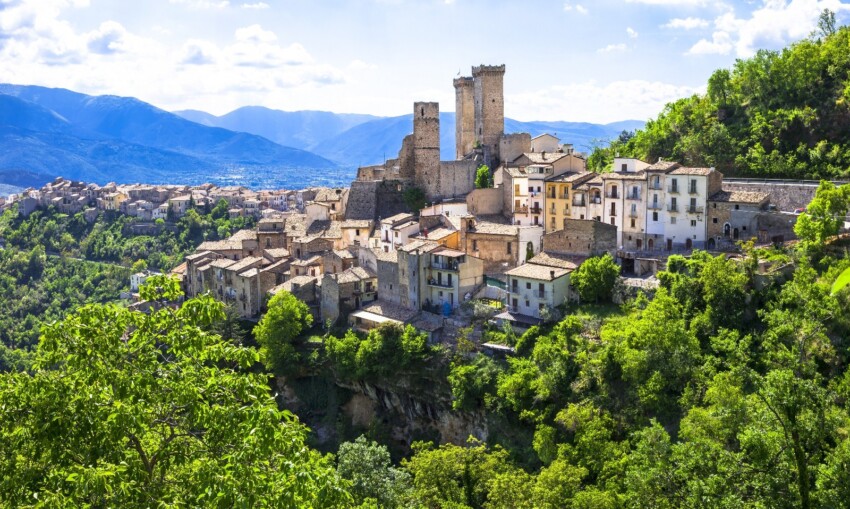
A small yet captivating town in L’Aquila province, Pacentro is a village that enchants all its visitors with its beautifully preserved medieval centre and natural heritage. The town sits within the Majella National Park at almost 700 metres altitude and has been included in the “Club of Italy’s Most Beautiful Villages“.
Pacentro’s position, just a few kilometres from Sulmona, has made it a popular destination for those seeking stays filled with nature, culture and relaxation. The earliest records of the town date back to the eighth century when Pacentro apparently came under the control of the San Vincenzo al Volturno monastery.
More substantial economic and urban development occurred during the Norman period (tenth–eleventh centuries) when the village took shape with dwellings built around a fortress. The town subsequently experienced a turbulent history, passing into the hands of various noble families including the Orsini, Colonna and Recupito of Raiano.
In the 1970s, Pacentro became the subject of a tourism regeneration programme that included castle restoration and the opening of accommodation facilities and visitor services.
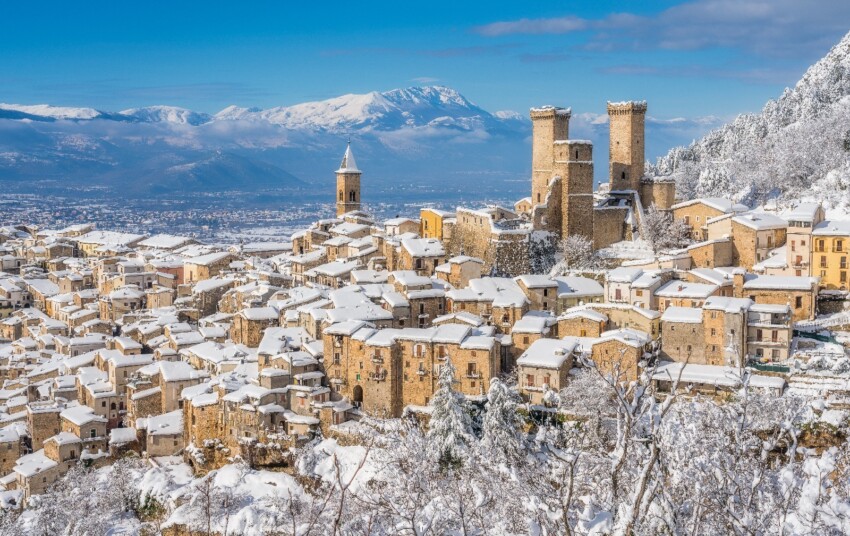
The lovely town of Pacentro is part of the Peligna Mountain Community and is a place you can easily explore on foot thanks to its narrow streets lined with ancient churches, stone houses and prestigious palaces.
The symbol of the town is Pacentro Castle, considered one of the best-preserved fortifications in Abruzzo that have survived to the present day. The castle was originally built by the Normans in the eleventh century but underwent several enlargement and restructuring works. The structure features a trapezoidal base with three tall square towers and three cylindrical corner turrets. After belonging to various noble families such as the Caldora, Cantelmo, Orsini and Colonna, the fortress became the property of the municipality, which carried out significant restoration work to make it visitable.
The heart of the town is currently Piazza del Popolo, which features a magnificent seventeenth-century fountain and the Church of Santa Maria Maggiore or della Misericordia, dating from the fifteenth century. The religious building has a white stone façade with three portals, whilst inside it features three naves with a central vault finely decorated with stuccowork by Attilio de Chellis. Near Piazza del Popolo is also Palazzo Rocca, now home to the Town Hall and Civic Museum. The building is finely decorated and features symbolic engravings carved into the stone paving slabs.
Other churches worth visiting include the Church of San Marcello, dating from the eleventh century and one of the town’s oldest churches, and the Church of San Marco from the seventeenth century. Also worth a visit is Casa “Marlurita”, the medieval home of Maria Loreta Pacella, now a museum housing nineteenth-century furnishings and objects.
Pacentro is also ideal for nature lovers, with numerous trails and footpaths winding through the surrounding countryside. Within the municipal territory you’ll also find Monte Amaro, which at 2,800 metres is the highest peak of the Majella.
Pacentro is a village offering simple yet welcoming accommodation for those wanting to spend a stay in a peaceful town setting.
The town does not have many accommodation facilities, so it’s advisable to book your stay well in advance. Alternatively, you can stay in nearby towns such as Sulmona, which boasts a wide range of hotels.
Pacentro is less than 10 km from Sulmona and is easily reached both by car and by public transport. By car from L’Aquila, take the A25 to the Pratola Peligna–Sulmona exit, then continue along the SS17 towards Sulmona. From Rome, take the A25 towards Pescara to the Pratola Peligna–Sulmona exit, then continue on the SS17.
Those wishing to reach the town by public transport can get to Sulmona railway station, from where you can catch one of the buses connecting the two towns or take a convenient taxi.
What's the weather at Pacentro? Below are the temperatures and the weather forecast at Pacentro for the next few days.
Pacentro is a charming village located within the Majella National Park, 90 km from L'Aquila, 160 km from Rome and 180 km from Naples.
 Hotel
Hotel  Budget accommodations
  Apartments
  Family Hotel
  Luxury Hotel
  Resorts