IL BORGO DI ROCCA CALASCIO
Calascio - Località Rocca Calascio - Via della Torre snc
Book now
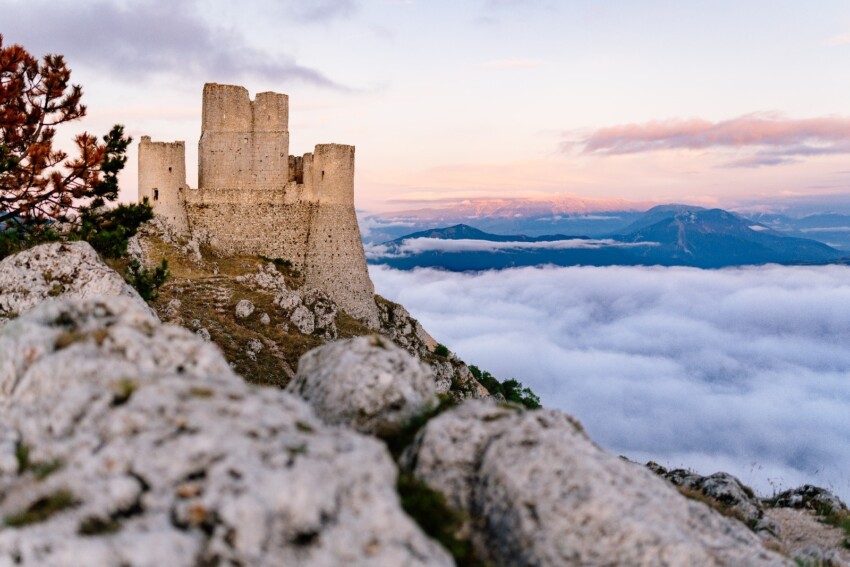
Rocca Calascio, a small hamlet in the Abruzzese town of Calascio, is an ancient yet enchanting medieval village situated on a hilltop at 1,460 metres altitude. Located approximately three kilometres from Calascio itself, Rocca Calascio is home to a fortress built around the 12th century in a strategically advantageous position that allowed control of the Abruzzese valleys. This location was indeed a crucial military observation point that enabled the early detection of enemy attacks and maintained communication with other watchtowers in the area.
Following a violent earthquake in the 18th century, Rocca Calascio suffered extensive destruction, and the population subsequently decided to relocate further down the valley to the present-day town of Calascio. Over the decades, the fortress was unfortunately gradually abandoned until the 1980s, when this location was rediscovered and revitalised.
The magical atmosphere that defines this village, its history and the magnificent panoramic views surrounding it have made Rocca Calascio not only a much sought-after destination in Abruzzo but also a perfect filming location where several renowned directors have shot scenes for famous films.
Thanks to this interest, the Rocca Calascio Castle underwent restoration work whilst some buildings in the ancient medieval village were converted into hospitality facilities.
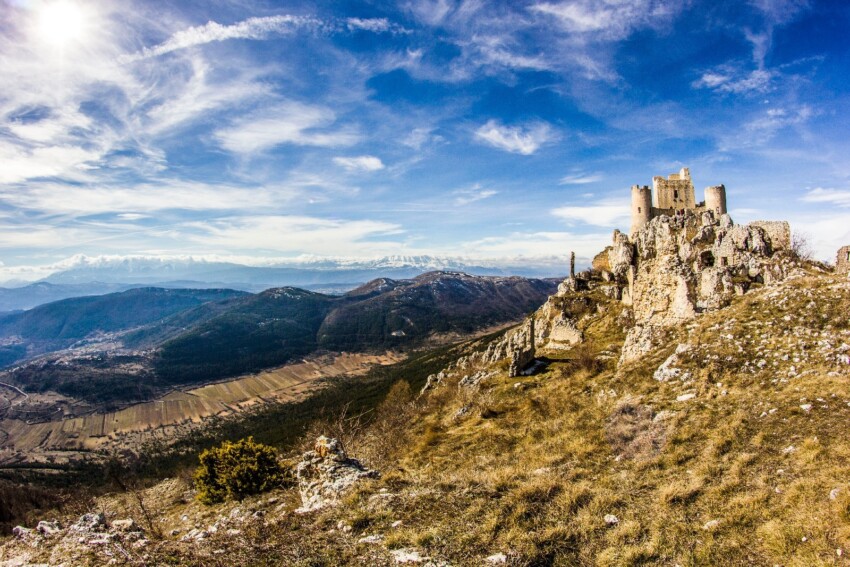
According to some sources, the Rocca Calascio Castle was built by Ruggero II d’Altavilla in the 12th century on the remains of an earlier Roman fortification. Its position, situated between the Campo Imperatore plateau, the Tirino valley and the Navelli plateau, made this fortress a truly strategic control centre.
Over the centuries the castle was owned by various noble families including the Pagliara, Colonna, Piccolomini, Todeschini, Cattaneo, Medici and Bourbon dynasties, who modified the building’s appearance several times. In the 15th century, under the ownership of Antonio Todeschini of the Piccolomini family, the curtain wall and four cylindrical towers with Ghibelline crenellations were constructed.
The structure, which was built entirely in local white stone, comprised a central keep of ancient origin, four corner towers with circular bases and a surrounding fortified wall. The castle’s position allowed it to control the entire surrounding territory, not only for defensive purposes but also to monitor routes used for transhumance.
Following restoration work carried out in the 1980s, which resulted in the architectural and functional recovery of the structure, the castle is now free to visit. From here you can also admire one of the most striking panoramas in Abruzzo, encompassing the main mountain ranges of the Apennines. To the north, you can see the entire Gran Sasso chain, to the south-east the Majella and to the south-west the Sirente-Velino.
The small village of Rocca Calascio sits along the road connecting Santo Stefano di Sessanio to the centre of Calascio town. This settlement was established because the castle’s modest size could not accommodate the entire population, who therefore lived outside the fortress. Access to the castle was provided by a wooden drawbridge, which no longer exists and has been replaced by a wooden ramp.
Following a series of violent earthquakes, the upper part of the settlement, closest to the castle, was abandoned between the 14th and 15th centuries, whilst the lower part was only deserted after the 1793 earthquake, which prompted the population to move to Calascio. The village is small and compact, characterised by narrow lanes lined with white stone buildings and small churches.
The stunning natural setting in which the castle is situated has attracted screenwriters, directors and actors over the years, who have chosen this location as a film set for various productions. Even before the structure was restored, films such as Amici miei – Atto IIº (1982) and Ladyhawke (1985) were filmed here. Subsequently, the castle hosted the filming of works including The Name of the Rose (1986) starring Sean Connery, The Event Horizon (2005) and other Italian and international films.
Following the restoration of Rocca Calascio Castle, the small village situated below the fortress also underwent renovation to enhance its appeal. Many of the buildings in the ancient settlement have become hospitality facilities, restaurants, small taverns or shops selling local souvenirs.
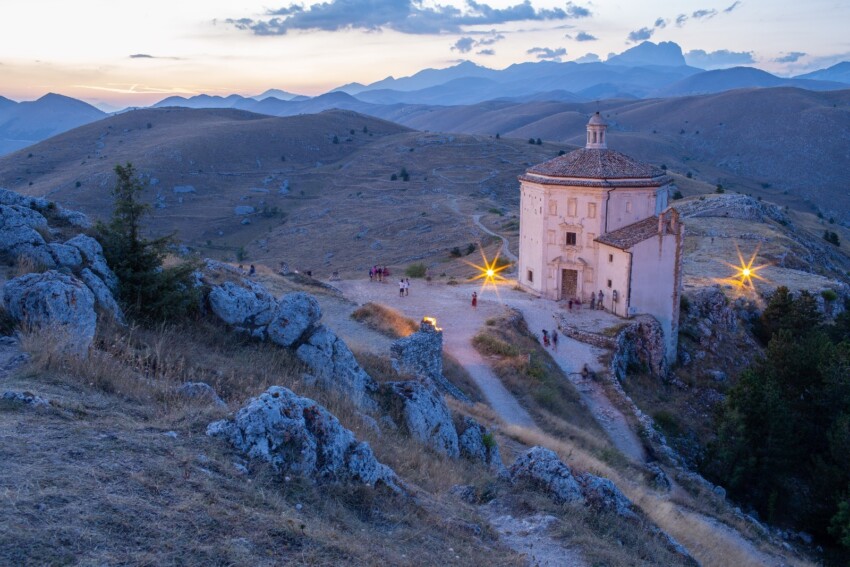
Near the Rocca stands the Church of Santa Maria della Pietà, a building erected between the 16th and 17th centuries on the site of a pre-existing Renaissance chapel. According to legend, this church was built at the location where the local population defeated a band of brigands who had been terrorising the area. The exterior of the building has an octagonal plan with an eight-segment dome, whilst the interior houses a painting depicting the miraculous Virgin and a sculpture of an armed San Michele.
The small village of Rocca Calascio has accommodation facilities housed in ancient town buildings that have been converted. Staying in the ancient village is certainly a unique and fascinating experience.
Alternatively, if you prefer to visit as a day trip, you can choose from the hotels available in Calascio or in nearby towns such as Santo Stefano di Sessanio or Castel del Monte.
To reach Rocca Calascio you need to pass through Calascio and park your car at the entrance to the ancient village. From there you must walk up to Rocca Calascio on foot, following a route of approximately half an hour that winds through the narrow winding lanes typical of medieval villages.
To reach Calascio by car from the north, you must first take the A14 and then the A24 motorway to the L’Aquila East exit; then take the State Road 17 and the SP8 towards Calascio. From Rome you need to take the A24 to the L’Aquila East exit, whilst from Naples take the A1 and then the A24.
From Calascio town there is also a paid shuttle service available that goes to Rocca Calascio hamlet. Local bus lines connect Calascio town with other Abruzzese towns such as L’Aquila, which is home to the nearest railway station.
Rocca Calascio is a hamlet within the municipality of Calascio, perched at 1,460 metres above sea level. The settlement lies 40 km from L'Aquila, 81 km from Pescara and 160 km from Rome.
 Hotel
Hotel  Budget accommodations
  Apartments
  Family Hotel
  Luxury Hotel
  Resorts