Hotel Cercone
Caramanico Terme - Viale Torre Alta 19
Book now
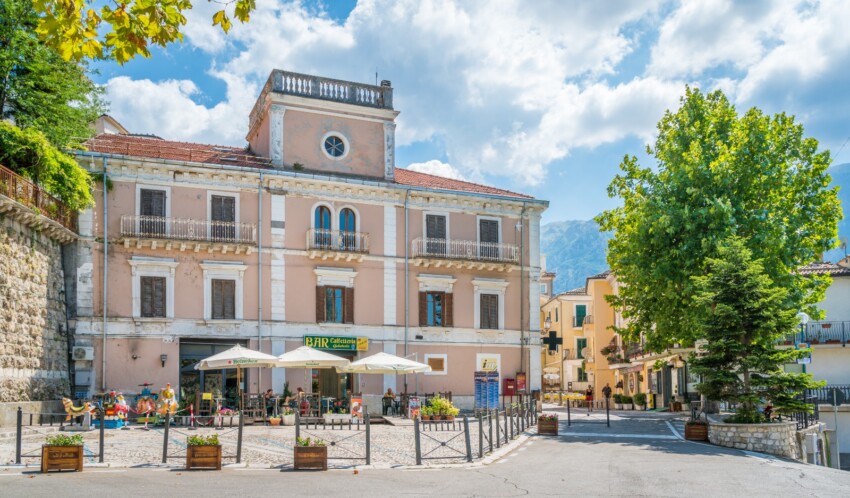
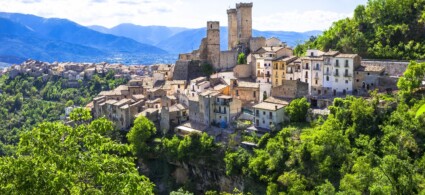
A small yet picturesque medieval town, Caramanico Terme sits at 650 metres above sea level in the heart of the Parco Nazionale della Majella and is renowned as an important spa centre. Nestled in the lush Orfento Valley, Caramanico is a village that belongs to the “Most Beautiful Villages in Italy” club and is a destination that perfectly combines relaxing getaways with nature.
The current town centre appears to have developed during the medieval period, around the 7th century, and was built according to the urban planning needs of the time, with a castle situated atop the hill and the town protected by walls, towers and gateways. Thanks to its location, the city held an important strategic role, as it formed an access route to Naples for those travelling from the Tiburtina-Valeria-Claudia road.
From the 16th century onwards, the presence of therapeutic waters came to light, though it was only in the 19th century that they were analysed, revealing the existence of two different types of water. The opening of the first thermal spa for therapeutic purposes took place in 1901, and from that moment on, the town became a renowned spa destination with facilities providing the highest-level services.
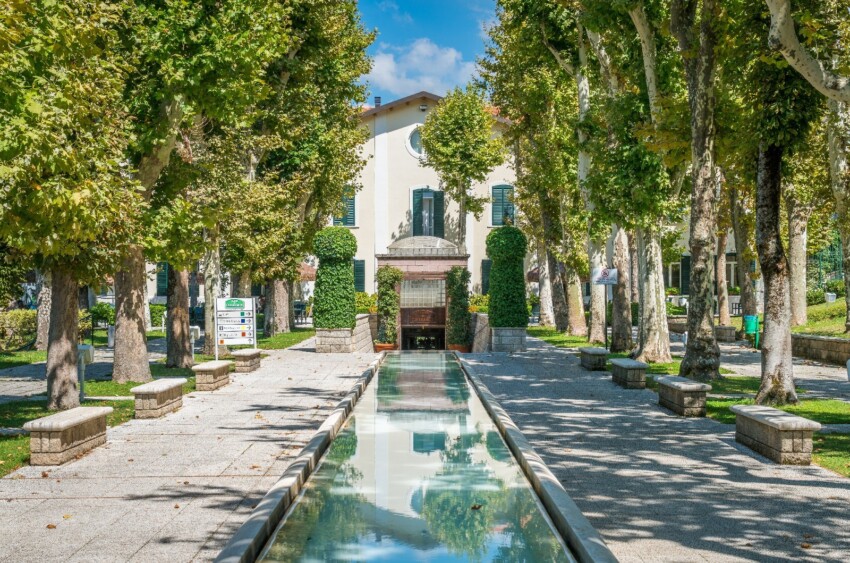
The Caramanico Thermal Spas feature two mineral waters: one low-mineral and diuretic, and another sulphurous and anti-inflammatory. These have made this town a highly sought-after destination for those requiring thermal therapy. The centre also offers wellness programmes featuring thermal and aesthetic treatments, massages, draining and relaxation therapies.
Salute and Gisella are the two sulphurous mineral springs renowned for their significant anti-inflammatory properties, which act on the respiratory, osteoarticular, digestive systems, the ear and the skin; whilst the other source present is Pisciarello, a low-mineral water with diuretic effect.
Thanks to the presence of these springs, excellent facilities and highly qualified staff, Caramanico presents itself as the ideal location not only for those seeking a wellness-focused stay but also for preventative, therapeutic and rehabilitative activities. Here you can find inhalation therapy, mud therapy treatments and hydropathic cures.
The centre also boasts an excellent Paediatric Department where treatments such as aerosol therapy, inhalations and nebulisations are carried out for the prevention or treatment of conditions affecting children’s respiratory or auditory systems.
Given the natural environment in which they are situated, the climate and the extensive range of services offered, these thermal spas, which also feature wellness pathways, represent an important point of reference not only in Abruzzo but across central Italy.
The village of Caramanico dates back to the Lombard period, when to defend against enemy invasions, a town was built following a strictly defensive structure, featuring narrow alleyways, fortified houses and, at the highest point of the hill, a fortress of which only ruins remain today.
A very ancient building in the town is the Abbey of Santa Maria Maggiore, which appears to have been built around the 11th century. The complex features Gothic-style exteriors with a splendid portal and sturdy walls. The interior, meanwhile, comprises three naves and has undergone various restoration works due to earthquakes, which almost entirely eliminated the original Romanesque layout in favour of a Baroque one.
Walking through the village streets, you’ll easily find the Church of S. Nicola, whose origins date back to the 14th century, though the building we see today is the result of work carried out in the late 15th century. The Church features three naves separated by a double row of pillars with 18th-century vaults adorned with splendid inlays; along the sides of the naves are altars decorated with stuccowork.
Not to be missed is a visit to the stunning Church of San Tommaso Becket, also known as the Church of San Tommaso di Paterno, dating back to the early 12th century. The building has a three-nave layout and houses inside the “holy column”, a quadrangular pillar with an original umbrella-shaped capital; the façade, with its projecting sections, features three portals and four semicolumns with a central rose window and two small single-light windows.
Caramanico Terme is a town rich in accommodation facilities. Those who visit for its thermal waters can stay at the Hotel Terme Maiella, the only hotel located within the Caramanico Thermal Spa establishment itself.
Other accommodation options, including hotels, bed and breakfasts, campsites and holiday homes, can be found close to the historic centre and allow easy access to both the thermal spa and various points of interest in town. Those who prefer a stay immersed in nature can choose properties outside the centre near the Riserva naturale dell’Orfento.
Getting to Caramanico Terme by car is very straightforward. From the north, take the A14 motorway and then the A25 motorway to the Scafa-Alanno exit. From there, take the SS5 and then the SS487 towards Caramanico Terme. From Rome, likewise take the A25 to the Scafa-Alanno exit.
The nearest airport is Pescara, approximately 50 km from Caramanico. From Pescara, you can reach the town by car via the E80 and then the A25 to the Scafa-Alanno exit.
The nearest railway station is at Scafa (on the Rome–Pescara line), 18.0 km from Caramanico. From there, you can take a local bus to Caramanico Terme.
What's the weather at Caramanico Terme? Below are the temperatures and the weather forecast at Caramanico Terme for the next few days.
Caramanico Terme is a charming village nestled within the stunning Orfento Valley, located at the heart of the Maiella National Park. The town lies 80 km from L'Aquila, 60 km from Sulmona and 200 km from Rome.
 Hotel
Hotel  Budget accommodations
  Apartments
  Family Hotel
 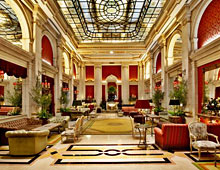 Luxury Hotel
 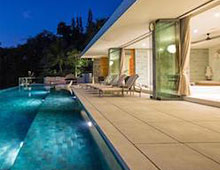 Resorts