Il Salice
Civitella del Tronto - Viale Vibrata 13
Book now
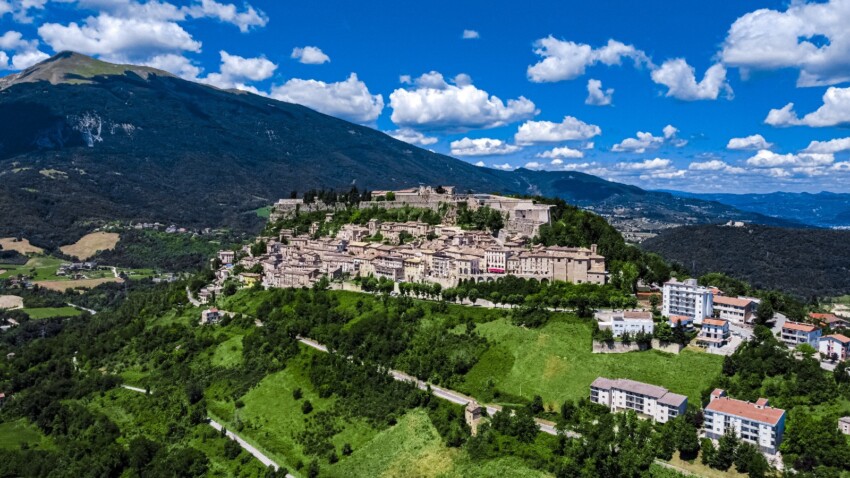
Listed within the prestigious “Italy’s Most Beautiful Villages” circuit, Civitella del Tronto is a charming small town considered one of Abruzzo’s finest gems. Located in the Val Vibrata, in the northernmost part of the region almost on the border with the Marche, Civitella sits atop a rocky travertine crag that offers visitors magnificent panoramic views.
The village’s name, Civitella, appears to derive from the Latin “Civitas”, while Tronto was added in reference to the Tronto River that flows through this area. The town seems to have been founded around the 9th and 10th centuries when early settlers established themselves here to escape the Saracen raids that were common at the time. Due to its strategic position on the border with the Papal States, Civitella always held considerable strategic importance.
In the 16th century, Philip II of Habsburg, King of Spain, ordered the construction of the Fortress of Civitella del Tronto, also known as the Spanish Fortress, a military complex built for tactical and defensive purposes. Following Habsburg rule, the city came under Bourbon dominion until Italian unification. During the Second World War, Civitella became a tragic chapter in history as it housed three concentration camps where nearly two hundred Jews were imprisoned.
Today, the town is a truly captivating blend of history, art and nature and for these qualities stands out as one of the region’s most interesting destinations. Its location means Civitella appeals not only to those wishing to admire its historical and architectural heritage, but also serves as a base for many visitors heading to the Gran Sasso and Monti della Laga National Park.
Civitella del Tronto has managed to preserve its ancient medieval village structure, characterised by narrow alleyways, steep staircases and charming squares. It’s home to the “Ruetta”, considered to be Italy’s narrowest street.
Entry to the town is through Porta Napoli1, the only gate to survive intact to the present day, which leads directly to Piazza Filippo Pepe, where you can enjoy a spectacular panoramic view.
Perched at the highest point of the town on a hilltop dominating the village centre, at approximately 600 metres altitude, stands the Fortress of Civitella del Tronto. Built for defensive purposes in the 16th century by Philip II of Habsburg, King of Spain, the fortress is characterised by an elliptical shape and is one of the most imposing feats of military engineering, covering an area of around 25,000 square metres.
During the 18th century, the Bourbons undertook significant modifications to the military structure, altering parts of the layout which now comprises elements from various periods arranged on different levels and connected by ramps and staircases.
From an architectural perspective, the complex can be divided into two sections: one designated for residential use and another reserved for defensive purposes with tall guard towers. Today the structure is almost entirely open to visitors and contains military quarters, powder magazines, dungeons as well as ovens, stables and the Museum of Arms and Ancient Maps.
The narrow lanes that characterise the historic centre of Civitella del Tronto and wind upwards towards the fortress are often extremely tight and steep. Originally, these formed part of a sophisticated urban layout designed to minimise the effectiveness of potential enemy attacks.
These winding alleyways allow only one person to pass through at a time and were built deliberately to funnel assailants through these narrow passages.
The narrowest lane in Civitella del Tronto is precisely la Ruetta, also known as “Ruetta, Italy’s narrowest street”. Its name appears to derive from the French word “rue”, which means street.
The Church of San Lorenzo, dating from the 16th century, stands in Piazza Filippo Pepe with a Renaissance-style façade and a Latin cross floor plan. The building has undergone various interventions and restoration works that have altered its appearance over time. The interior features a single nave with two side chapels added. The church preserves an 18th-century organ as well as altars, fine stucco work and canvases from the 16th and 17th centuries including a Madonna of the Rosary, a Visitation and an Annunciation.
The Church of San Francesco, built in 1326 by the monk Fra’ Guglielmo, was for nearly three centuries an important centre for religious and cultural promotion where both clergy and lay people learned to read and write.
The interior of the church has undergone various modifications and now displays Baroque styling with a single nave, a walnut choir and columns dating from the 15th century. The façade has been preserved in its original characteristics and features Gothic-Romanesque style with an elegant 14th-century rose window in stone.
Santa Maria dei Lumi is a Marian sanctuary comprising the church, a monastic house and a cloister. Erected in 1882 and dedicated to the Madonna of the Lights, the sanctuary stands outside the town walls of Civitella. The church features a Romanesque façade whilst its interior is in Renaissance style with two naves. The high altar is wooden and in the central niche stands a statue of the Madonna of the Lights.
At Largo Rosati you can admire a monument executed in marble in neoclassical style and dedicated to Matteo Wade. Commissioned in 1829 by Francis I of the House of Bourbon, King of the Two Sicilies, the monument was created by Bernardo Tacca and Tito Angelici to honour Matteo Wade, an Irish officer who defended the town during a siege by Napoleon’s forces. Major Matteo Wade was considered a hero, having managed to withstand attacks from the Grande Armée for over four months.
The Salinello Gorges are located within the adjacent Nature Reserve, which forms part of the Gran Sasso and Monti della Laga National Park. The gorges are a spectacular canyon carved by the Salinello River between the Monti Gemelli, Foltrone and Girella mountains.
The trail through the gorges follows the course carved by the river and features numerous karst caves such as the Grotta Sant’Angelo. This cave, some 30 metres deep and approximately 10 metres wide, is a pilgrimage destination as an altar dedicated to the Archangel Michael was constructed here.
In the following map you can see the location of the main places of interest mentioned in this article.
Accommodation options in the historic centre of Civitella del Tronto are somewhat limited; however, those visiting Civitella for hiking or to enjoy nature can choose from agritourism properties nestled in the surrounding hills, from which it’s easier to reach the Gran Sasso and Monti della Laga National Park.
Reaching Civitella del Tronto by car from the north is straightforward: take the A14 motorway to the Ascoli Piceno – San Benedetto del Tronto exit towards Ascoli Piceno, then take the RA 11. From the south, take the A14 (towards Ancona) to the Teramo – Giulianova – Mosciano Sant’Angelo exit, then take the SS 80 towards Teramo and finally the SS 81 towards Civitella del Tronto. From Rome, take the A24 to the Teramo Est exit and from there continue along the SS 81.
The town has no railway station; the nearest ones are in Teramo or Giulianova. Once you arrive at either station, you can take a bus operated by the regional TUA transport company to reach Civitella. The nearest airports are Pescara, approximately 75 km away, and Ancona, about 129 km away.
Civitella del Tronto is a hilltop town in inland Abruzzo, situated close to the regional border with the Marche. The town lies less than 20 km from Teramo, 30 km from the coastal city of Giulianova and around 80 km from L'Aquila, the region's capital.
 Hotel
Hotel  Budget accommodations
  Apartments
  Family Hotel
  Luxury Hotel
  Resorts